

Introduction
I bought the six-thousand-pound-plus Moor Amps manaDAC at the start of the year for its analogue sound, which results from a hybrid DAC architecture that utilises both Delta-Sigma and resistor-ladder technologies. Though minimalist (no DSD) and functional (no filters), it is still immaculate, natural, and long-listening, and it’s my Reference, by a street.
However, the Chinese group Topping has a different approach to Hybrid DACs. Released last year, this particular DAC incorporates PSRM (Precision Stream Reconstruction Matrix); read on.
Design
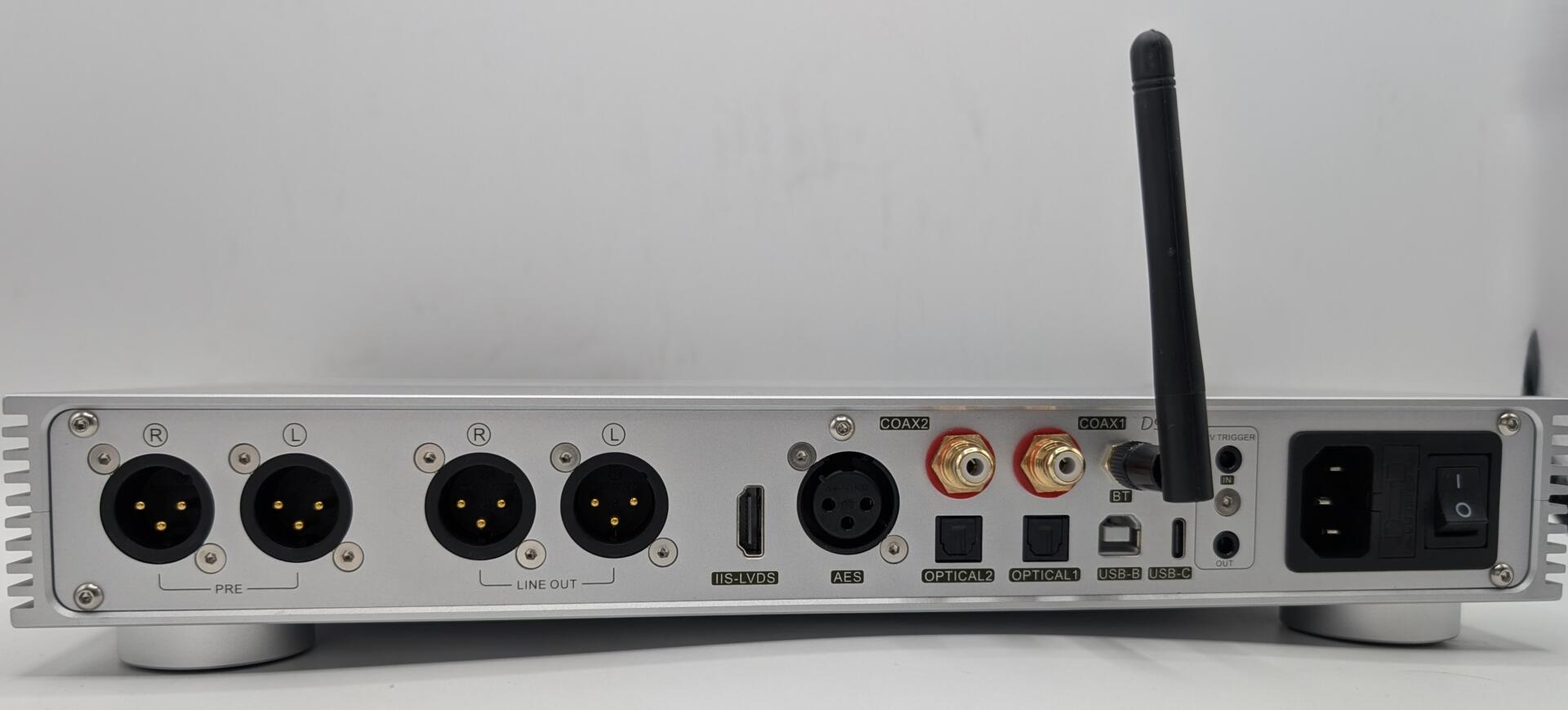
The Topping D900 DAC itself is a DAC only with no streaming module (there is Bluetooth, strangely) or headphone output (the A900 looks to have this covered); it has Line and Preamplifier balanced XLR outputs (there is no single-ended output option, though distributor Mark Dolbear of Electromod is perfectly happy using these converters; get the right one, though: male or female.
On the input side, the D900 is well served with USB-C, USB-B, 2x optical, 2x coaxial, AES/EBU and IIS LVDS inputs. The Bluetooth 5.1 module supports LDAC (up to 24-bit/96kHz), aptX Adaptive (up to 24-bit/96kHz), aptX HD, aptX Low Latency, aptX (standard), AAC, and SBC.
There is a 10-band parametric equaliser accessible in a Windows application. Other features include a touchscreen and a solid aluminium remote control.
The unit features an ultra-low noise power supply that underpins the PSRM technology. Topping has developed a stable, noise-free, purely resistive output power supply, ensuring each DAC element performs with absolute accuracy.
PSRM Technology
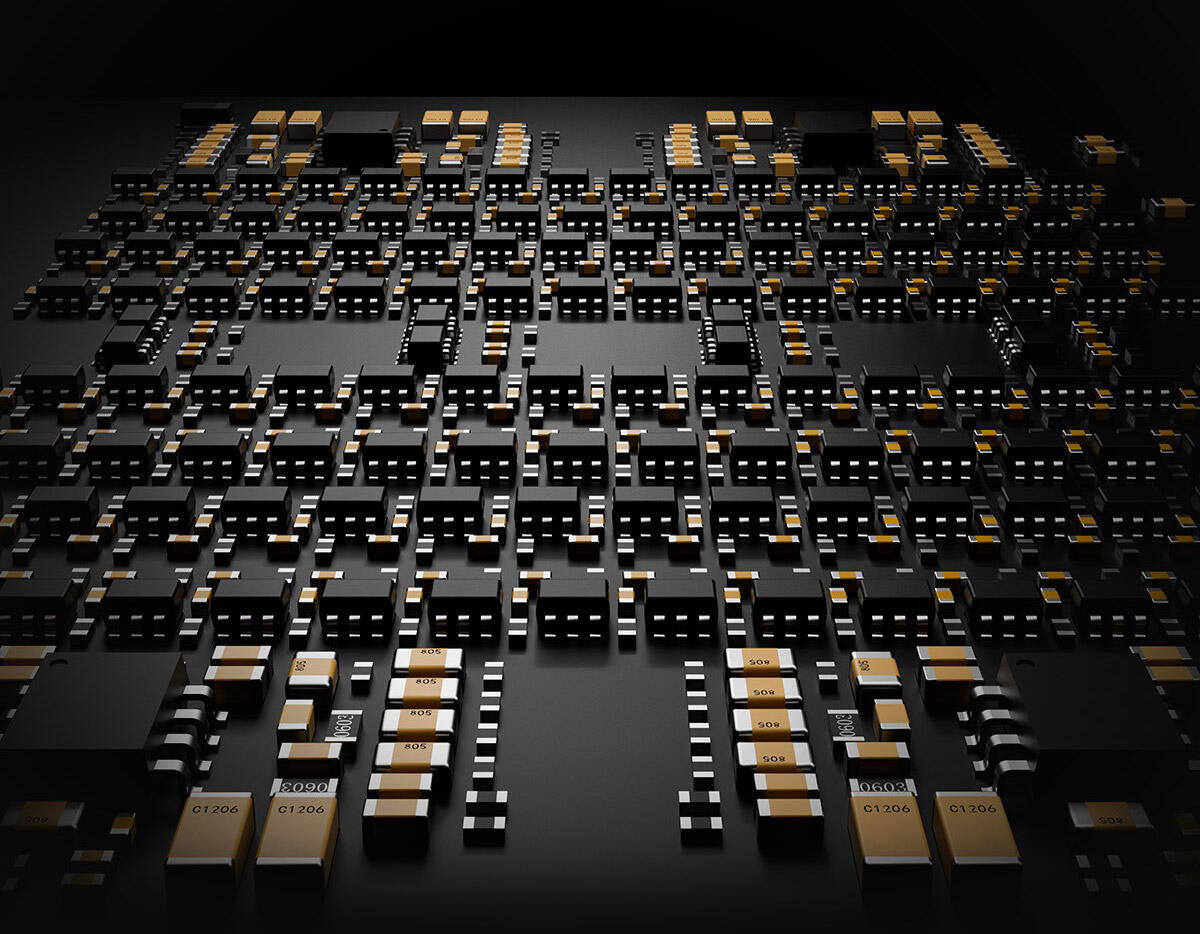
Precision Stream Reconstruction Matrix technology is a discrete 1-bit decoding architecture developed by Topping themselves. This PSRM technology uses individual electronic components for the conversion process rather than an integrated chip-based solution. Although this sounds like an R2R design, it is essentially a 1-bit delta-sigma DAC; whereas R2R uses a ladder of resistors to represent different bit values, PSRM uses a high-frequency 1-bit stream.
The process itself turns digital audio into sound using 32 custom 1-bit modules per channel. It converts each audio sample into a high-speed (millions-per-second) stream of pulses, with pulse density determining the volume level. A built-in filter then smooths these pulses into a clean analogue audio signal. While this looks like standard delta-sigma technology, the specific design and software are uniquely engineered by Topping.
Signal to Noise
PSRM, being a collection of individual components, isolates noise in a way that integrated chips simply can’t. Topping has mastered independent voltage references and ultra-fast switching logic; this delivers exceptional signal-to-noise ratios that are incredibly hard to achieve ordinarily. The SNR at1 kHz is 131dB; this is exceptionally high.
Crosstalk
Additionally, the D900’s PSRM architecture is fully balanced, with 32 discrete elements (high-speed switching voltage references) for the left channel and 32 for the right, ensuring maximum channel separation and, therefore, vanishingly low crosstalk.
Quality
The unit itself is absolutely gorgeous. The lines are sleek and clean, and the bare aluminium finish is silk to the touch. The unit is on the thinner side and not ‘standard width’ which makes it a talking point but very aesthetic.
There’s a small touchscreen next to a volume knob that clicks with satisfaction.
The remote is functional, matches the same aluminium chassis, and is heavy. The remote covers most of the functionality, but with such a small screen in a conventional 2-channel setup (i.e. not desktop), it’s not that useful, save for volume control if you’re on the Pre-Out, which has no latency at all.
Specification and Price
Topping D900 DAC
DAC Architecture: Custom discrete 1-bit PSMR (Precision Stream Reconstruction Matrix) with 32 elements per channel
THD+N @A-wt (with an A-rated filter) XLR (Line Out): <0.000055% @1kHz, XLR (PRE): <0.000055% @1kHz
THD @No-wt (no weighted filter) 45kBw XLR (Line Out): <0.00015% @20-20kHz, XLR (PRE): <0.00015% @20-20kHz
SNR @A-wt XLR (Line Out): 131dB @1kHz, XLR (PRE): 131dB @1kHz
Dynamic Range @A-wt XLR (Line Out): 131dB @1kHz, XLR (PRE): 131dB @1kHz
Frequency Response XLR (Line Out): 20Hz-20kHz (±0.3dB), 20Hz-40kHz (±1.0dB), XLR (PRE): 20Hz-20kHz (±0.3dB), 20Hz-40kHz (±1.0dB)
Output Level XLR (Line Out): 4.2Vrms @0dBFS (4V Mode), 5.2Vrms @0dBFS (5V Mode), XLR (PRE): 10.5Vrms @0dBFS (4V Mode), 13.0Vrms @0dBFS (5V Mode)
Noise @A-wt XLR (Line Out): <1.5uVrms, XLR (PRE): <1.6uVrms
Channel Crosstalk XLR (Line Out): -147dB @1kHz, XLR (PRE): -147dB @1kHz
Channel Balance 0.3 dB
Output Impedance 100Ω
Hardware EQ: Built-in 10-band customizable PEQ
Dimensions 33.0cm x 5.7cm x 21.0cm
Weight: 2.52 kg
Full details are on the company’s site.
Availability – Topping’s official distributor is Electromod; the D900 DAC/preamp is available from other selected retailers at an RRP of £1799.







Performance
Review Equipment
I’m using the HF&MS Reference System without the Moor Amps preamplifier (it has no XLR input); however, the Pre-Out from the D900 is beautiful into the Moor Amps Angel 6 power amplifier direct (see caveats below) with Tellurium Q Ultra Silver II XLRs. The manaDAC has taken a back seat.
Since its arrival, the Eversolo DMP-A6 transport has given way to the dorpo DMP-A1 as a streaming transport for the D900, connected via USB-B. The performance of this is excellent, with Qobuz Connect doing the heavy lifting.
Physically
The unit is slim and, in my case, uses my preamplifier, which is off, as an isolation platform. It looks delicious, with the dorpo off to the side. There’s plenty of room around the back.
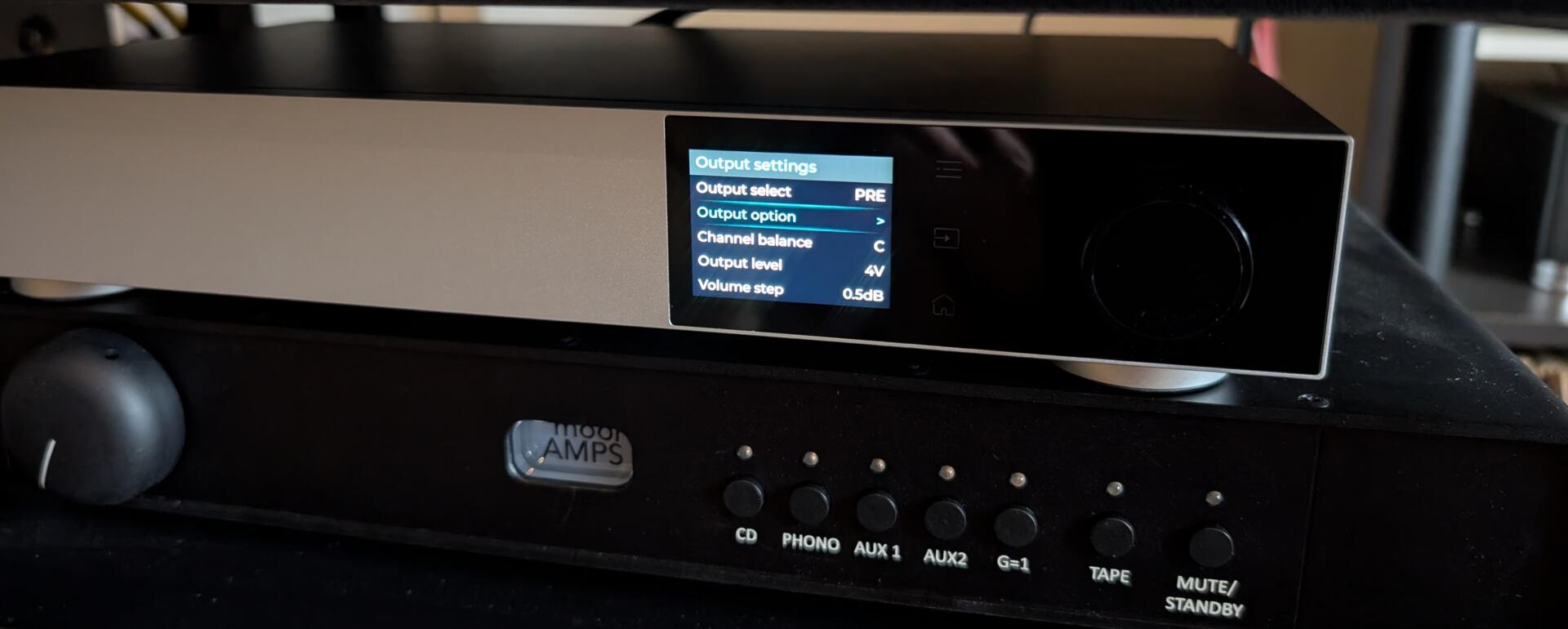
I’ve not really used the touchscreen other than fiddling with it on setup. The small screen can show dB volume, a VU meter or a spectrum analyser, all of which are nice to look at if a little small.
One thing I do like is the unit knows if you’re switching sources between USB, Optical or Bluetooth.
The remote volume control is good and very responsive, with no latency on the volume/mute functions.
How Does it Perform?
I was clear at the outset that the high 13Vrms voltage output direct from the D900 to my low feedback power amplifier could possibly fry a few bits of my kit, so I carefully reduced the volume step in the D900 settings to 0.5dB and the XLR output stage down to 4V (I’ve experienced something similar with the Angel 6 before). Happily, for me with the D900, turning the volume down via the sophisticated 18-relay R2R analogue volume matrix does not affect sound quality.
I thought I would let the D900 settle in for a few hours, which is what I normally do, but I have to say swapping out my manaDAC to the D900 was a bit of a moment. Basically, the D900 is stunning. It’s the timing and pace I really hear, straight away. The Angel 6 is so dynamic and effortless; this is reviewing nirvana.
The next thing to hit me was the space in the soundstage; for example, tracks like Arooj Aftab’s Last Night sound as good as I’ve heard it in the isobaric Titan 505s. Each element of the track is perfectly smooth. The elements of the song sit together perfectly; the spaces are marked. The double bass and snare rattle detail is there, and it is pure musical joy; the room feels bigger with this D900.
There are a few DAC tracks that I do go to. Wrapped Around Your Finger (Qobuz 16-bit, 44.1kHz) by the Police is epic; Stuart Copeland dominates this track with continuous flicks and tricks. At all points the cymbals are crystalline, light, transient yet clearly separate from Sting’s bassline and Summers’ noodling.
Celeste’s Strange (Qobuz 16-bit, 44.1kHz) has a smoky vocal, front and centre. This is an incredible track lyrically and musically. There is a huge soundstage here with such delicate and painful vocals. There’s no flattening of the soundstage, which remains deep and spacious as the track builds.
Ryan Adams’ Dylanesque To Be Young (Is to Be Sad, Is to Be High) (Qobuz 24-bit, 44.1kHz) can get chaotic at times with a congested midrange, but with this setup the track remains energetic yet controlled and clear.
Finally, Dire Straits’ Private Investigations (Qobuz 16-bit, 44.1kHz) is highly dynamic, yet its forceful finale remains controlled, rhythmic, full-bodied, and smooth.
PEQ
The D900 can be tuned by downloading the Topping Tune application for Windows 11 or iOS. The PEQ needs to be physically connected via USB to make it work.
It would be good if the EQ could connect with Bluetooth; is this a thing? I’ve disabled PEQ as the unit is quite a way from my desktop PC. I’ve not really had the time to play with the PEQ, which I may have liked, but this does look like a nice addition to the spec.
Bluetooth
To be honest, I thought the inclusion of Bluetooth was a bit odd, but I imagine it is an easy one to put in. The Bluetooth module paired without fuss to my Google Pixel 8. It sounds fine; I was following the cricket (the Lord’s hum was noteworthy), which was a bit strange with this Reference System (a phone call was directed helpfully to the phone, cutting the cricket stream). I wouldn’t particularly look for this input in such a high-end unit.
Playlists
Playlists used in the evaluation of the D900.


Thoughts
Whilst acknowledging that the nuances of DACs are properly marginal (since many, many of these DACs are terrific these days, really), this DAC has really challenged my perception of a source component in terms of price and performance.
Let’s butcher a metaphor for fun. If England’s Madueke takes Saka’s place on the right wing due to injury (say), plays well and scores goals, it can be hard to bring Saka back, despite his clear talent over the previous season. This is a case of squad selection, and if you lose your place in the first team you can end up being out of favour.
In this case, the manaDAC is Saka, but he has been overtaken in this review seamlessly by the D900 (Madueke). In other words, I absolutely love the manaDAC, and I’ll default happily back to it, but this D900 is very special indeed, particularly at this price (£1799). I note from Google that Bukayo Saka’s estimated market value is €110 million, making him more than double Noni Madueke’s €50 million.
My thoughts and ears wandered to the FiiO K19, their flagship DAC/Amp/headphone amp (£1199). This upstart FiiO has an 8-Channel ESS HyperStream ESS9039SPRO flagship DAC and is crystal clear, as is the D900, though the K19 is a fraction brighter. The recently reviewed iFi Audio Valkyrie (£1699) is very flexible and a tailored solution. It is sort of portable in a way the other two are not. Its sound can also be tailored. Both of these options have headphone outputs, something the D900 eschews in favour of performance and a focus on DAC technology.
Although Topping has a Head-Fi-type reputation (in my eyes/ears), this D900 is not really a desktop unit. You would need the matching A900 (£1199) headphone amplifier for a surely sensational desktop experience. Now that would give the iFi Audio iDSD Phantom (or the Valkyrie) a run for its money for sure.
The manaDAC has that edge in musicality that’s so hard to define (also, I’ve bought it, so I have to say that). But it is three times the price. This D900 really challenges the DAC segment, as I’ve mentioned, across price ranges, thanks to its stunning performance.
I note too, as someone without XLR options into my preamplifier, the Topping DX9 Discrete, which has the same DAC technology (though only 16 PSRM discrete elements per channel, not the 32 in the D900), has an RCA output, a line-out, and a headphone amplifier option at £1299.
Overall
There’s no hint of sharp, bright Chi-Fi with this Topping D900. This is a warm, super-clean, and precise DAC with excellence at the forefront of its design, yet it retains musicality. The technology here is exceptional and can support many higher-end systems, including this one.

Love
- Refined sound
- Clean
- Technology
- Price
- Simplicity
- Many inputs
Like
- Quality build
- Pre-Out
- Voltage output options
- Desktop option with an A900
- Auto source switching
Wish
- I’d like the DAC-only version of this with an RCA output that would better suit my passive preamplifier
- I had an A900 with it
- Bluetooth for PEQ
Topping D900 DAC Highlights
Related Posts


IFi Audio GO link 2 details released
Ifi Audio has announced details of its GO Link 2,…
Exposure DAC – ‘Built for the future of music’
Exposure Electronics has announced a new DAC,…
iFi Audio Valkyrie – Flagship Portable DAC with DSD Remastering
Looking like the rear diffuser of a hyper-fast…
MOON North Collection 681 Network Player/DAC and 641 Integrated Amplifier
MOON’s new North Collection, launched last year,…

HF&MS Best of 2023 – Eversolo DMP-A6
The next award this week goes, inevitably, to the…


