
Introduction
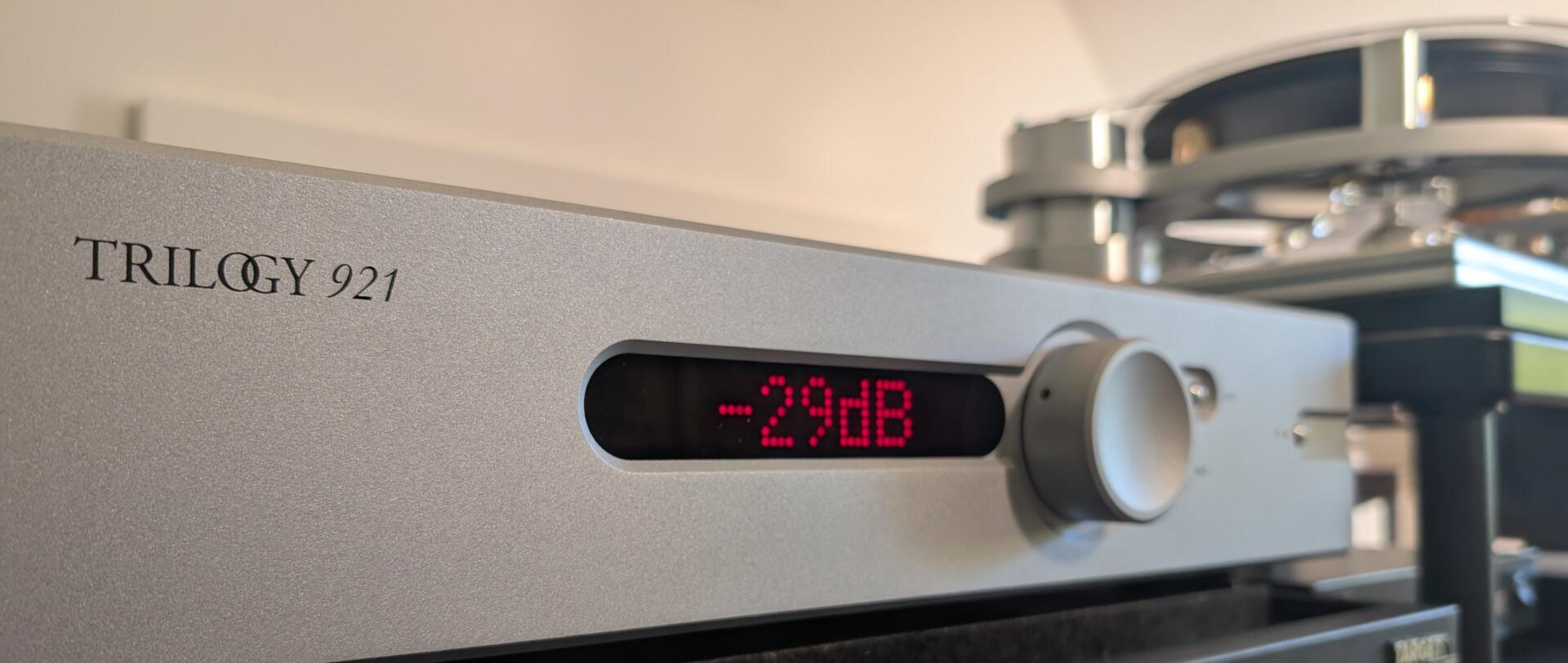
Trilogy Audio has always felt to me like a premium brand to admire from afar, rather like a Bentley: something to look at and love, but not necessarily to own. With the 925 integrated amplifier priced at £18,500, Trilogy was beyond aspirational. Now, however, the brand has introduced the ‘entry-level’ 921 integrated amplifier. It is still a serious investment, but one that feels a little more attainable, especially if you are prepared to sell a few unused electronics to help fund it.
Design
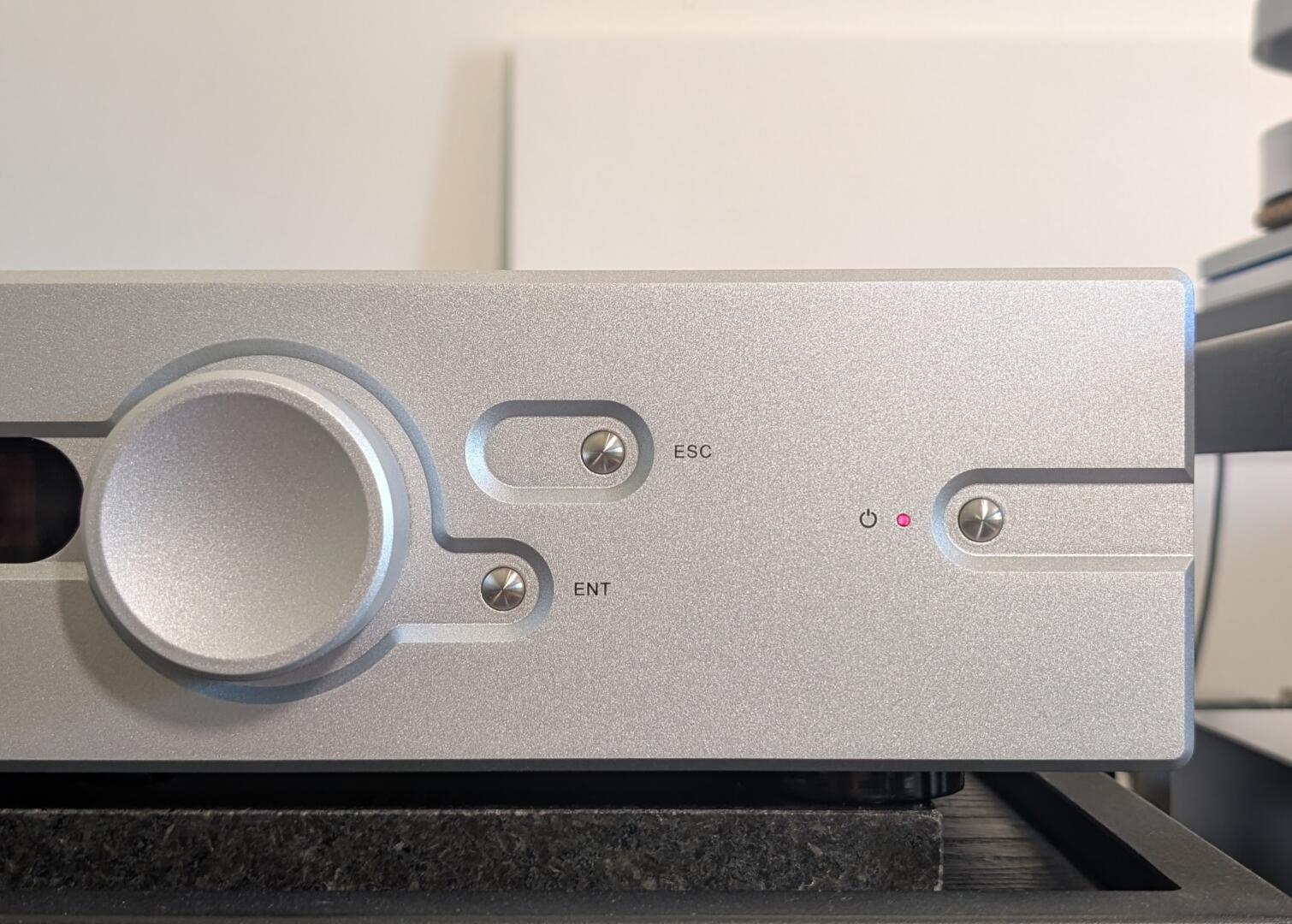
The Trilogy 921 is an all-analogue integrated amplifier. Designer Nic Poulson devised this unit with a single gain stage that handles all the required voltage gain, rather than a pre- and power-style arrangement. This single ultra-linear gain stage requires a custom-designed transformer, which is a unique selling point of this amplifier. This voltage-gain cell is stacked directly above the PCB (printed circuit board), shortening internal signal paths and contributing to faster signal delivery and reduced noise, particularly electromagnetic interference.
Separate windings on the custom transformer supply the rectification and capacitor banks on each left and right amplifier module. The 40,000 µF (microFarads) of custom capacitance per channel offers a huge amount of control for even the toughest speaker loads.
Volume control is implemented as a JFET resistor ladder bank rather than a more traditional potentiometer, again reducing distortion in the signal path.
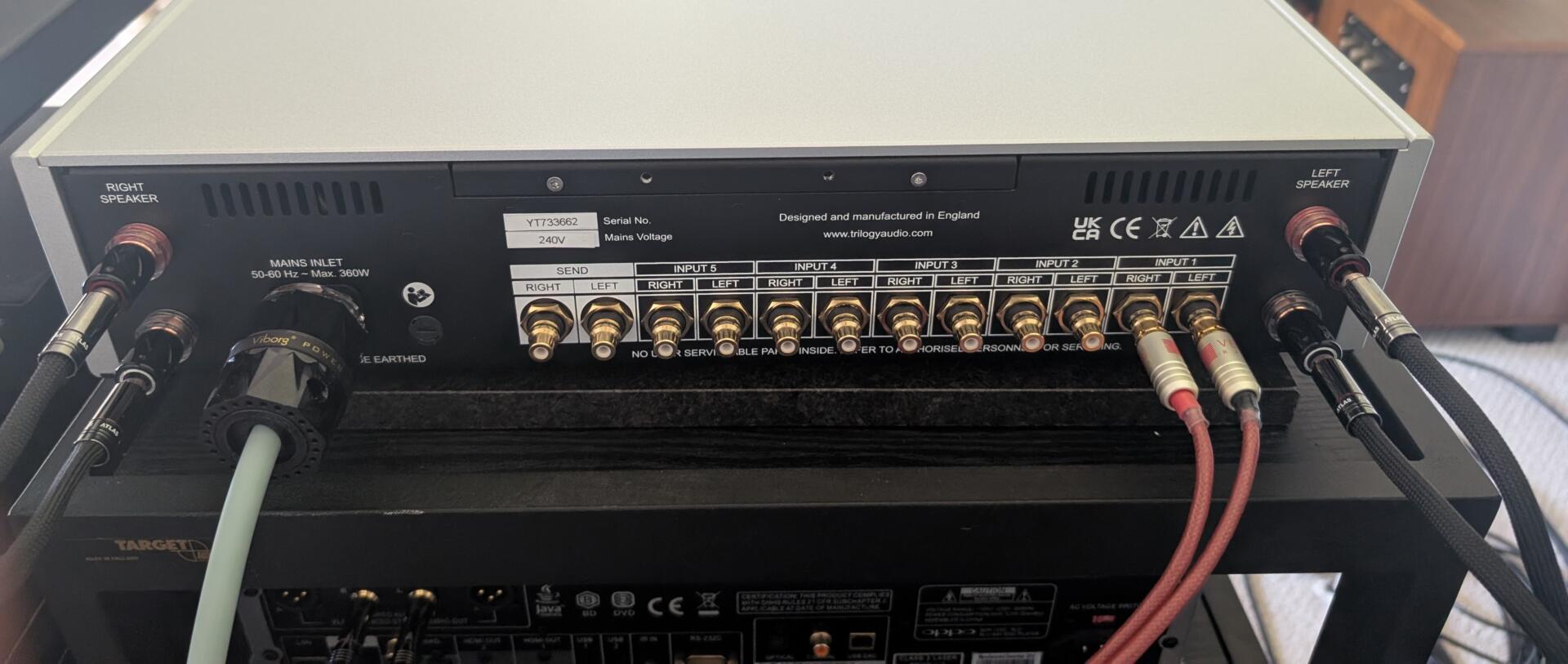
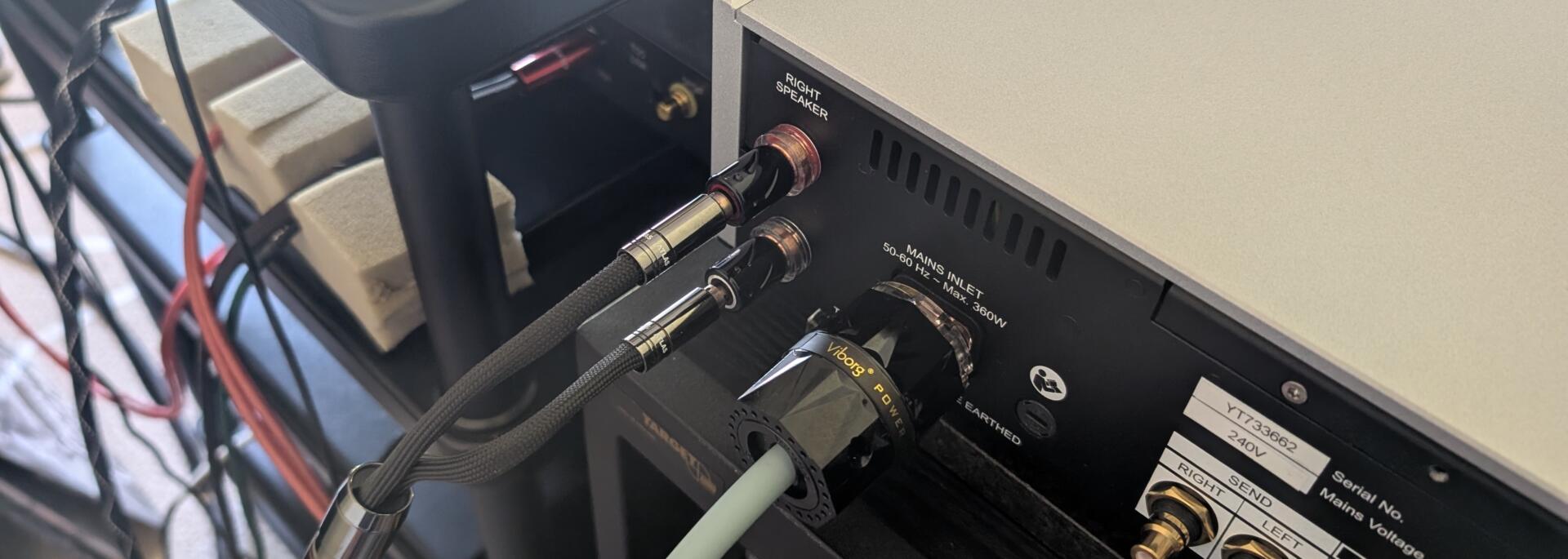
The Trilogy 921 has 5 pairs of single-ended RCA sockets; there is no digital platform in the 921, as mentioned. On the output side, there are the usual speaker binding posts on the outer side of the unit.
Quality
The Trilogy 921 is a full-width, solid, absolutely pristine-looking amplifier composed of thick, powder-coated, machined panels. The thick aluminium panels add mass and dampen mechanical vibration for the enclosed electronics.
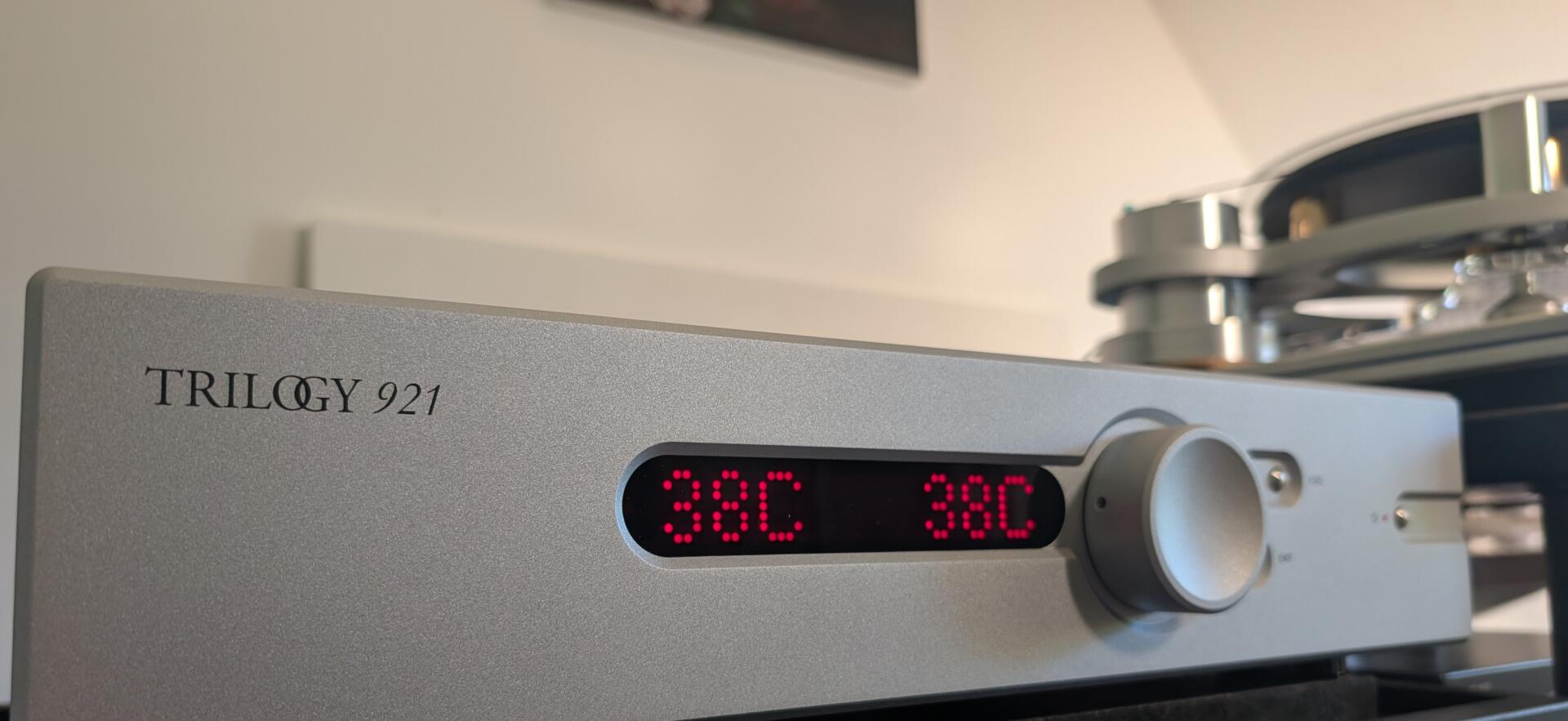
The large red dot matrix display is clearly visible even in a sunny room and is user-adjustable. The display includes volume and can show the operating temperature of each output channel, and the inputs can be programmed with your preferred source names.
The Trilogy 921 comes with a premium heavy-weight remote control.
Specification and Price
Trilogy 921 Integrated Amplifier
Size (including connectors etc) 465mm x 350 x 106 (W x D x H)
Weight 11 kg
Standby Power Consumption 1 Watt
Maximum Power Consumption 300 Watt
Input 5 pairs of RCA phono sockets
Input Impedance 50K Ohms
Input sensitivity 500mV
Rated Power 75 Watts per channel
Recommended Load Impedance 3-16 Ohms
Frequency Response 5-100KHz +/- 0.5dB
Distortion Less than 1% A weighted at rated output into 8 Ohms
Phase Inverting
List of Dealers here;
Full details are on the company’s site.
Price – £6200 – Silver, £6500 – Stealth Black







Performance
Review Equipment
This is a great sound, just two boxes. The source is an iFi Audio iDSD Phantom on Fixed output (HiFi, not Pro setting) with their iPower Elite supply to Input 1. I also have an Oppo BDP105 CD player to Input 2. The Kudos Audio Titan 505 loudspeakers have Atlas Mavros Loudspeaker cable with GRUN. The 505s are now benefiting from the Node Audio SS-1 supports under the feet. The source components have Vertere Redline RCA interconnects.
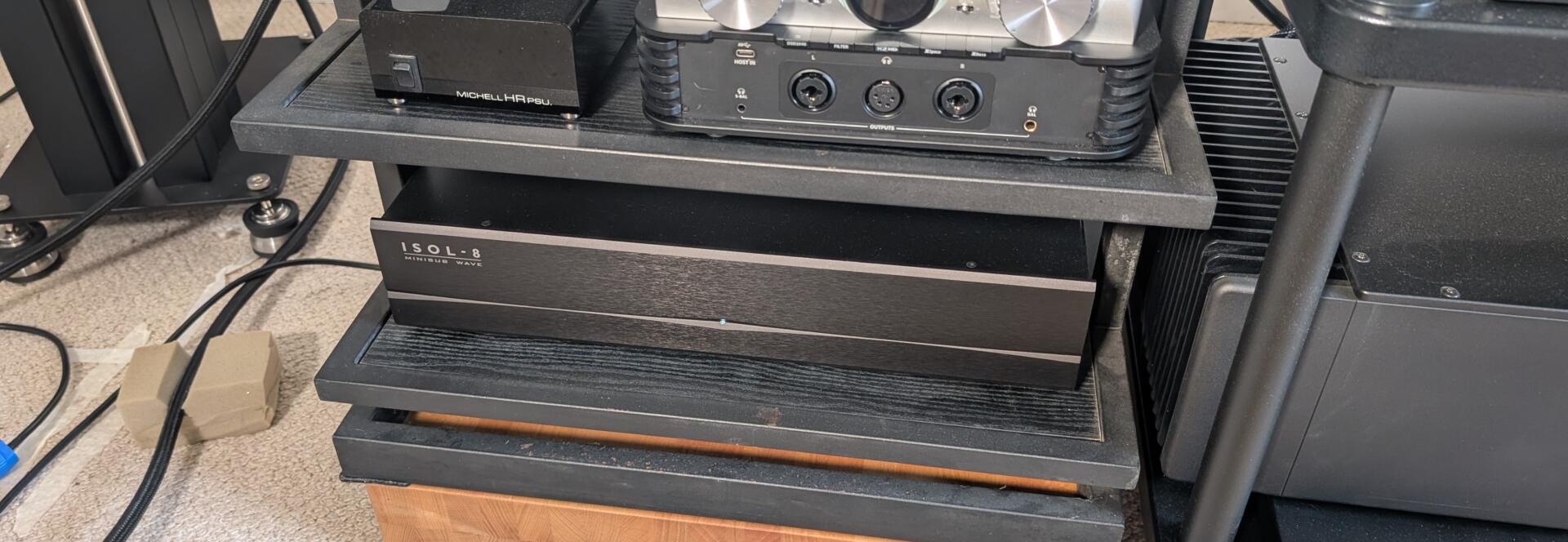
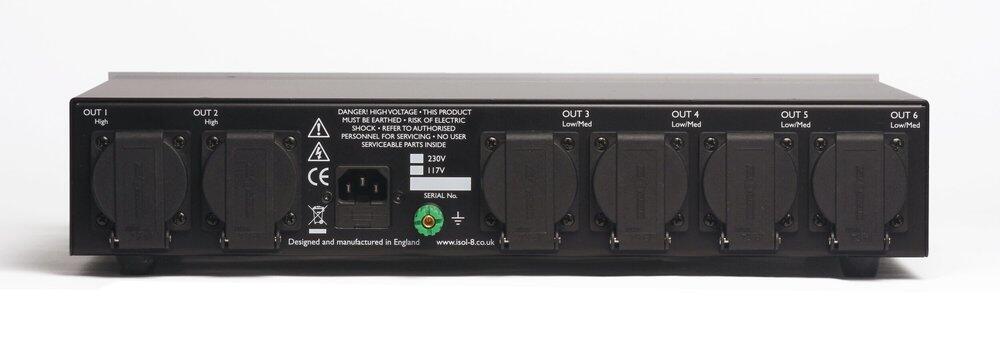
The Trilogy stable contains the ISOL-8 products. I have the ISOL-8 Minisub power conditioning unit (which cleans up the incoming sine-wave voltage) that now incorporates a DC Blocker with several rear-panel outputs tailored for amplifiers or other electronics, such as DACs. ISOL-8’s Minisub Axis technology targets both common- and differential-mode mains noise. I also have an ISOL-8 Isolink power cable for the 921. The three pin connections are at the rear of this unit.
Towards the end of the review, I received the latest Eversolo T10 streaming transport. I paired this with my Moor Amps manaDAC with excellent effect.
Physically
When switched on, the 921 displays ‘Warming Up’. This is fine. I’ve set the display brightness to 3. The remote control is a classy, soft-touch, aesthetic metal block that sits towards the top end, if not the top, of my ridiculous remote-control collection.
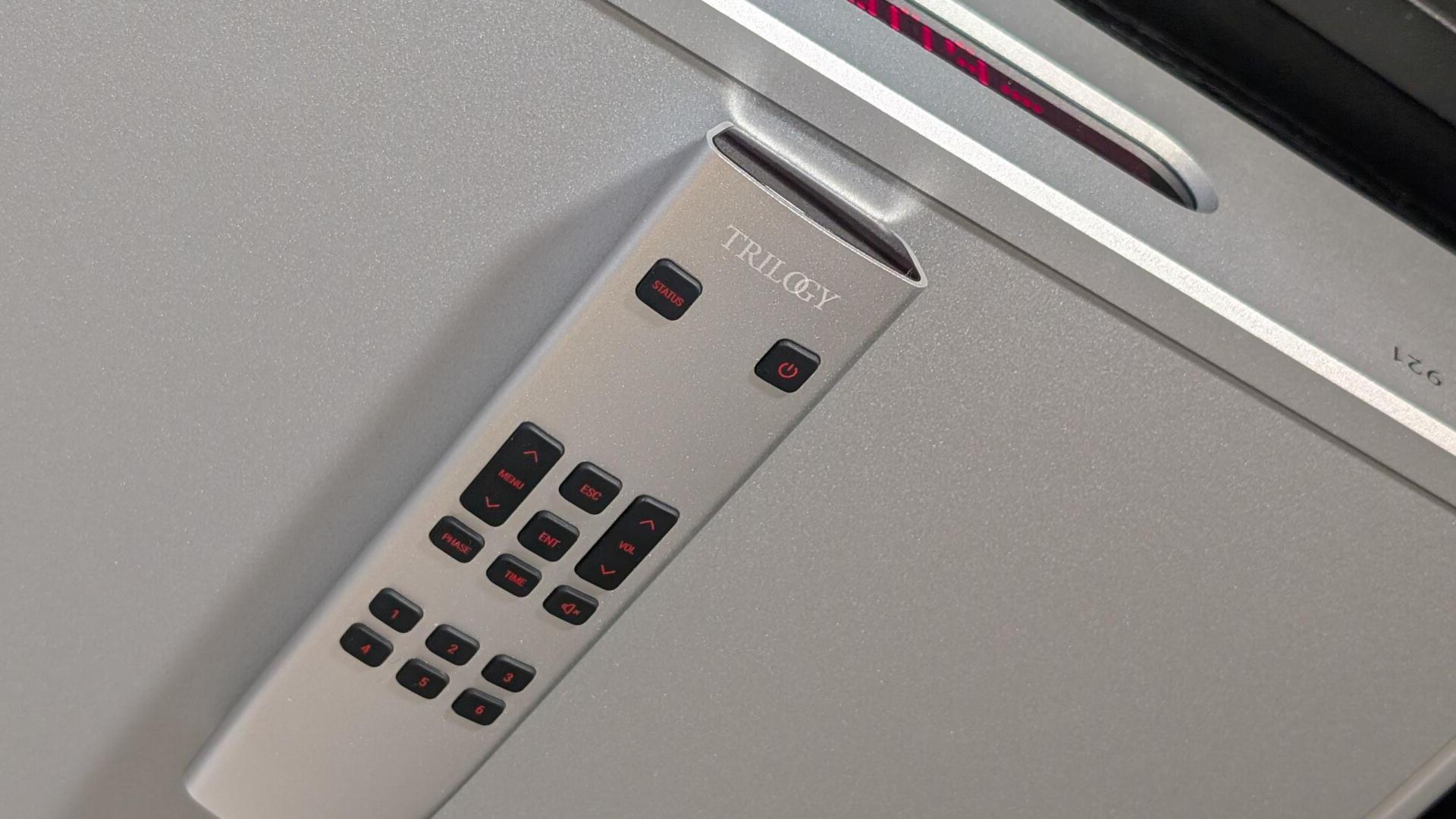
Trilogy Audio says the 921 is phase-inverting, meaning that, ideally, one should reverse the signals at one end of either the amplifier or the loudspeaker. This is because Trilogy Audio, in its pursuit of signal purity, has done away with the extra inverter that would flip the amplified signal to, let’s say, normal. In practice, I found it made little difference to the soundstage, and reversing the phase did not produce any tangible improvement. I have, though, flipped my signals at the amplifier binding posts for review purposes.
Using the iFi Audio iDSD Phantom streaming DAC
I’m using the Solid-State output option in the Phantom instead of the tubes to get a more accurate feel for the 921. I tend to a few familiar tracks to start with. My first impressions with the 505s are of a mature but natural soundstage. By this, I mean I hear an uncoloured presentation that has excellent timing. For example, straight away, the double bass supporting Arooj Aftab’s Last Night (Qobuz 24-bit, 96kHz) is delivered cleanly and precisely to the loudspeakers, and the timing sounds direct and perfectly natural. There’s layering to the soundstage with the rattle of the snare coming through to the rear of the presentation, where it should be; this is absolutely lovely.
The isobaric loudspeakers respond well to the amplification. I find they perform better a fraction louder than I usually listen to, though when I get the groove, I always end up turning things up anyway, which seems to suit the 921 with the 505s.
Transparency and tonal balance
Transparency is the defining quality here. I spent time trying to identify the Trilogy 921’s sound signature, but I’m increasingly convinced that it does not impose one in any obvious way. Instead, it allows the rest of the system to speak clearly and naturally.
A&W: vocal clarity and bass control
Lana Del Rey’s A&W (Qobuz 24-bit, 48kHz) demonstrates this particularly well. The midrange vocal sits cleanly at the front and centre of the presentation, while the isobaric bass response towards the end of the track, around 5’30”, is grippy and fast. There is no slurring and no added warmth, yet the sound never becomes clinical; it remains completely natural. Of course, that is a testament not only to the amplifier, but also to the source and loudspeakers working with it.
Further listening impressions
Ryan Adams’ piano version of New York, New York (Qobuz 16-bit, 44.1kHz) is beautifully delivered. The Trilogy 921 captures the atmosphere of this Carnegie Hall live recording with real conviction, giving the performance an emotional pull that feels immediate and personal.
Pete Doherty’s Lost Art of Murder (Qobuz 16-bit, 44.1kHz) is equally revealing. It comes through with striking detail and clarity, holding attention from the first phrase. This track cuts the day in half, beautiful, just listen to the lyrics.
With the Moor Amps manaDAC
Scaling the source up feels like a decent idea, and the manaDAC is my preferred DAC for its unprecedented analogue presentation. Paired with a proper streaming transport, the latest Eversolo T10 is a premium source befitting a premium amplifier. The above vocal tracks are delivered with a resolution I have not heard for a long time.
However, turning things up for a few tracks, FONTAINS DC’s Starburster (Qobuz 24-bit, 44.1kHz) gets things a little more toe-tapping; here, though, there’s no midrange clutter, and it seems laser-clear. My guilty pleasure, The Weeknd’s Save Your Tears – Remix (Qobuz 24-bit, 44.1kHz) is similarly punchy and clear. Paul Oakenfold’s punchy Starry Eyed Surprise (Qobuz 16-bit, 44.1kHz) has a booming bass line, and here, again, it is well delivered. Finally, a bit of cool old-school 70s disco from Gino Soccio showcases the forceful delivery and control of this amplifier.
Playlists
Playlists used in the evaluation of the Trilogy Audio 921 Integrated Amplifier.

Thoughts
We are in Rega Osiris, PMC Cor, Chord Ultima, Moor Amps 4i, and Sugden i4 territory here in this privileged £6000- £8000 price range. None of these other integrateds have a digital platform either. If you are looking at this price range, you will be well served by any of these British superstars. Some might consider Hegel’s H400, not to mention Luxman and Accuphase options from overseas.
But this Trilogy 921 has a more natural presentation than some of the above, and it must be heard before committing to any of the other prestige brands. As a Naim Fanboy pondering an upgrade to the Naim Audio New Classic 250 (£5,700), I find this 921 has reset my thinking quite dramatically.
What Three Words
Dynamic – Natural – Lifetime
Overall
The Trilogy 921 Integrated Amplifier is a dynamic and natural performer in this system. It feels like a lifetime investment in a premium British brand that will never let you down. Priced over £6,000 to £6,500, this ‘entry-level’ option from Trilogy is an amplifier you can be proud of, knowing it comes from a pedigree audiophile stable.

Love
- Natural sound
- Solid build
- Probably the last amplifier you would buy
Like
- Finish
- Remote control
Wish
- I’m always naively going to wish for one or two XLR inputs
- Stealth black looks amazing in the pictures
Trilogy 921 Integrated Amplifier Highlights
Related Posts

Eversolo Introduces the AMP-F8 Class AB Power Amplifier
The Eversolo AMP-F8 is a high-performance Class…

Musical Fidelity M5xi & M6xi Integrated Amplifiers Announced
Henley Audio has announced the Musical Fidelity…
Ultrafide Announces Accessible Power Amplifier
The SP500 amplifier is a more affordable…


