Introduction
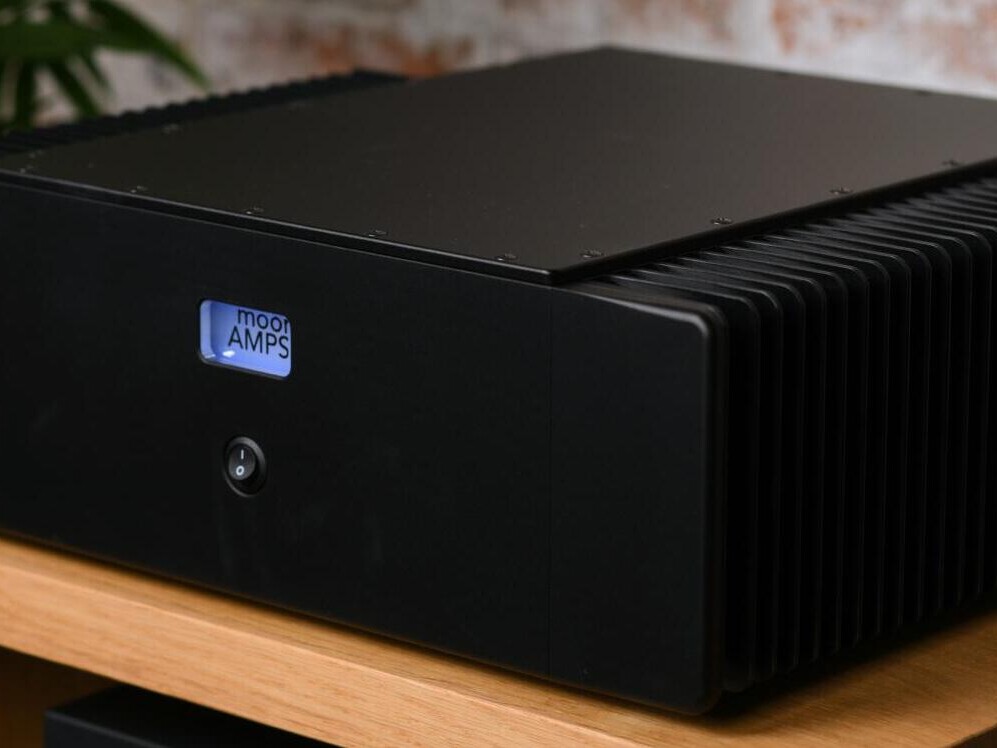
I have had a few incredible highlights in the last ten years, and many of these have been early listens to upcoming products, such as a very early listen to the 3D-printed Node Audio Hylixa loudspeakers at 30,000 pounds and the effortless Moor Amps Angel 6 power amplifier. One of these two I HAD to buy; the other was just a dream. Has Moor Amps done it again with their new manaDAC?
First, the most obvious question is why manaDAC? Tim Narramore, the designer at Moor Amps, explains that the family name comes from a farm near the village of Manaton on Dartmoor, which is where Moor Amps is named after. The ‘mana’ bit also lends itself to the old English form of manna, and that’s what you feed Angels with. Hence, a manaDAC to feed Angel amplifiers! Works for me.
Design
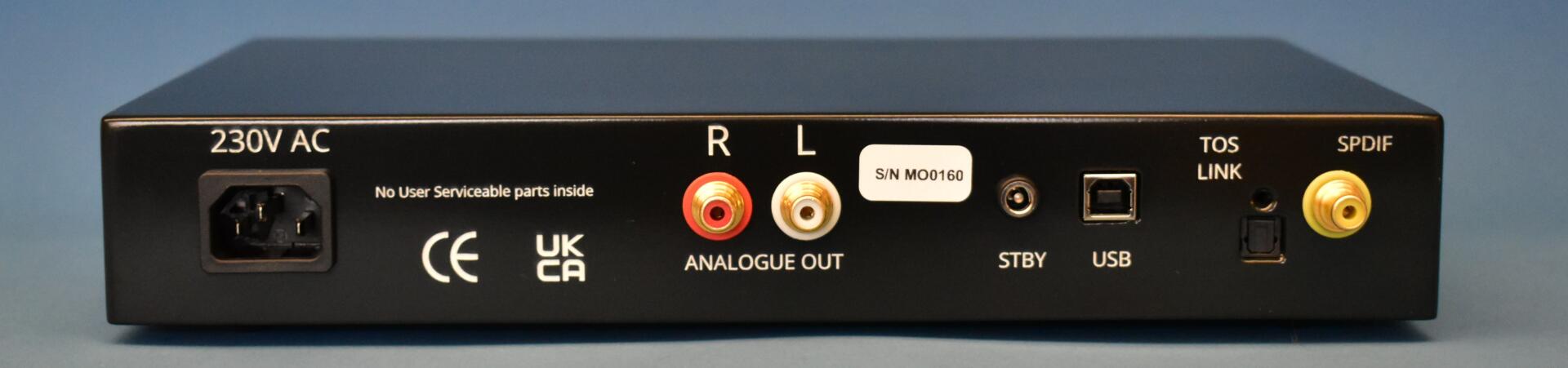
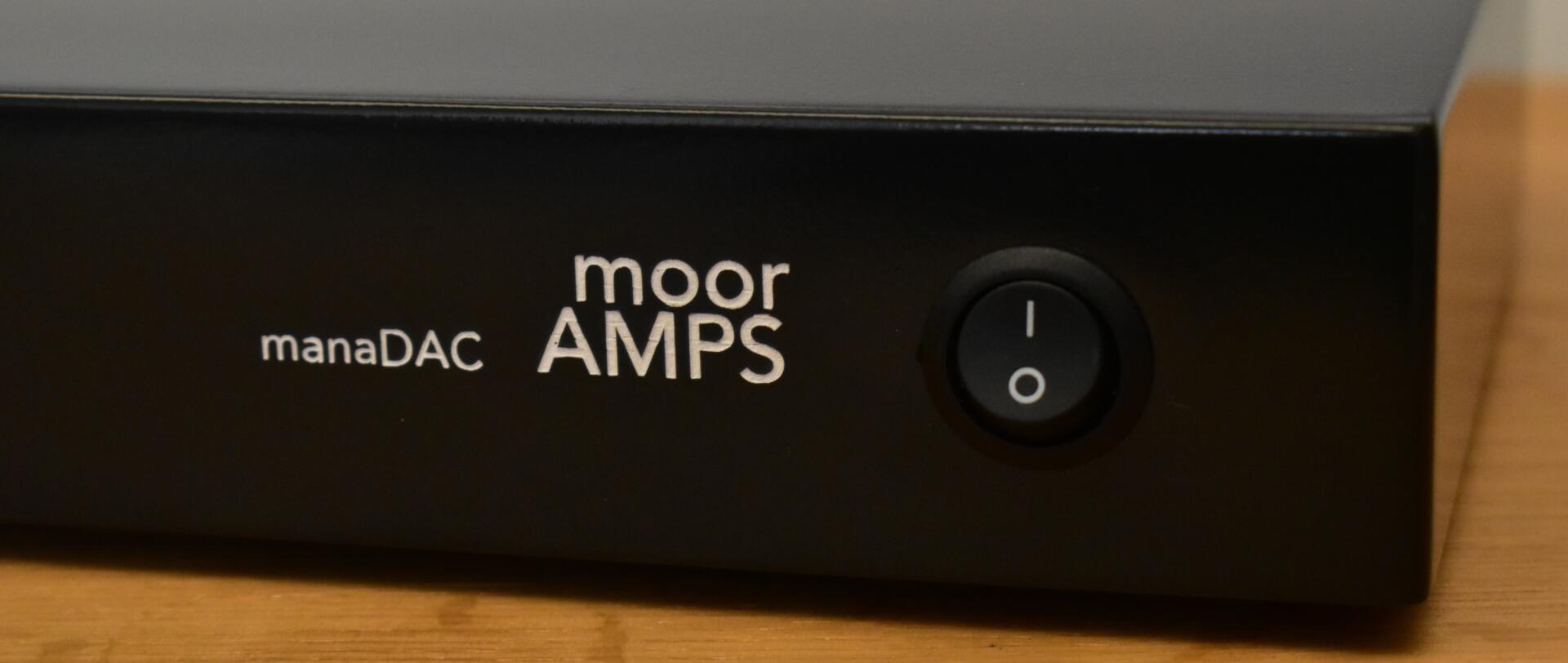
The Moor Amps manaDAC is a straight DAC with just three inputs (Toslink, Coax and USB B) and a single pair of analogue RCA outputs. There are absolutely no frills here; it is like the philosophy of the Angel 6, 4, or the Angel-Pre, with an unerring focus on musical quality.
The manaDAC has a pair of PCM1794A DAC chips operating in dual mono mode*. These chips are an update of the Burr-Brown PCM1794 chip, using their Advanced Segment architecture, which they claim is a hybrid Resistor-Ladder and Sigma-Delta DAC. There is basically no additional DSP (digital signal processing). It is all pre-programmed in the code, so there are no filter options with this manaDAC. Some may like this (like me), others may not.
The DAC feeds into a discrete I/V (current-to-voltage) stage using a pair of transistors on a single die. This is done to achieve the best thermal matching and transient performance, along with a low-IMD (intermodulation distortion) amplifier stage.
Tim Narramore, the designer of the Moor Amps manaDAC (and the Angels), understands that power supplies and grounding are key to DAC performance, keeping noise out of the critical analogue stages. As such, the manaDAC is designed to keep circulating power-supply currents out of the analogue stages. To keep supply rails pure and fully isolated from each other, the manaDAC uses 3 separate mains transformers and 18 voltage regulators.
Tim Narramore goes on to say;
Reducing jitter on the clock arriving at the DAC chip is also a key element of transparency and the communication of micro-detail and spatial information in music. The USB input on the manaDAC not only benefits from full optical isolation to keep digital noise out of the analogue path, but also has built in re-clocking, with very high stability oscillators keeping jitter down to around 300fs (femtoseconds) at the point where the clock enters the PCM1794A DAC.
The manaDAC casing is a ‘3D-printed’ composite construction with a bioplastic made from renewable plant-based materials and reinforced with carbon fibre, mass loaded with a brass plate and further damped with polyurethane rubber layers. This composite material was chosen over initial samples off the testing bench that were affected by the initial standard (aluminium) casing options.
In the manaDAC, the analogue section is on a separate PCB (printed circuit board) from the power supply, connected by flexible cables to avoid any small transformer vibrations transmitting into the sensitive circuits.
The DAC board is mounted to this heavy, mass-loaded, and damped lid. The lid is then suspended on polyurethane rubber isolation mounts like a record deck, and the base plate is another composite of plastic, copper, and PU rubber damping. This housing isolates the DAC board from its surroundings, enabling a clean signal pathway without added interference.
*each PCM1794A chip is dedicated entirely to one channel (left or right) with the benefit of improving channel separation, reducing crosstalk, and lowering the noise floor
Quality
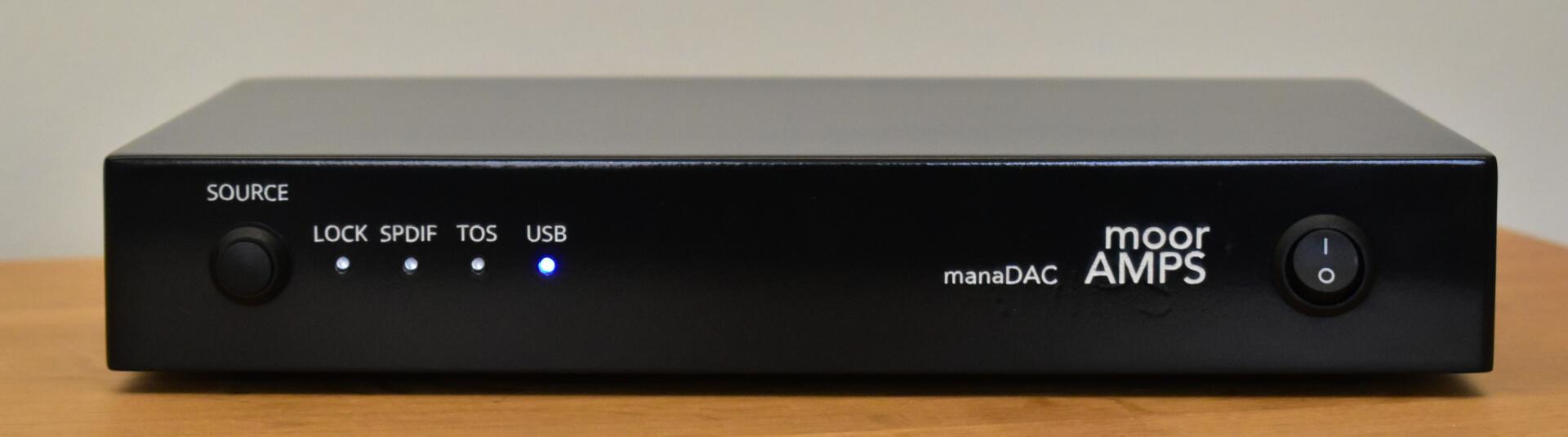
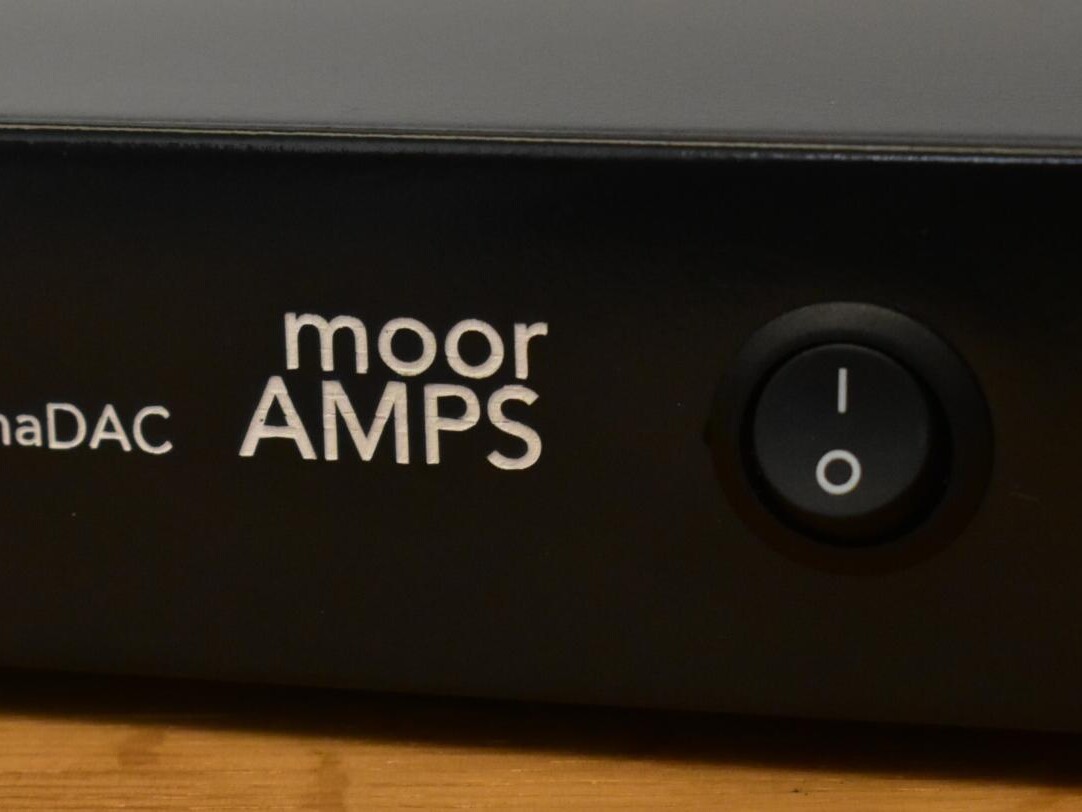
The one-piece 3D-printed case has a smooth industrial feel, with no joins visible. The DAC sits on some rudimentary but seemingly effective recessed rubber feet on its base. There is a surprising weight to the manaDAC that reflects the power handling detailed in the above design section.

Specification and Price
Moor Amps manaDAC
Output: Stereo RCA Output 2V RMS
Frequency Response: DC (direct current, zero-frequency signal) to 20,000Hz +/- 0.5dB
THD+N (Total Harmonic Distortion + Noise): < 0.002 %
Dynamic Range: > 124 dB
Power Supply: 230V AC / 50 Hz, < 10 W.
Standby: < 0.5W
Inputs (PCM Only, no DSD)
SPDIF:RCA, Transformer Isolation
TOS Link: Fibreoptic Isolation
USB B: Type B, Full Optical Isolation, femtosecond reclocking
PCM Formats: 44.1 kHz, 16- or 24-bit, 48 kHz, 16- or 24-bit, 88.2 kHz, 16- or 24-bit, 96 kHz, 16- or 24-bit, 176.4 kHz, 16- or 24-bit, 192 kHz, 16- or 24-bit
Dimensions: W 305mm x D 201mm x H 53mm
Weight: 3.69Kg
Mains Power: IEC inlet cable for 230V AC 50Hz
Price – RRP £6250 inc VAT
Availability – Now via the Moor Amps Dealer Network. Click here







Performance
Review Equipment
I’m using a Melco-based source on the quiet side of an ADOT optical data converter, paired with the Eversolo DMP-A6 as a streaming transport. The manaDAC is replacing a temporary 200-pound FiiO ladder DAC and/or an iFi Pro iDSD DAC. I have an Atlas Mavros USB with Grun between the transport and the DAC.
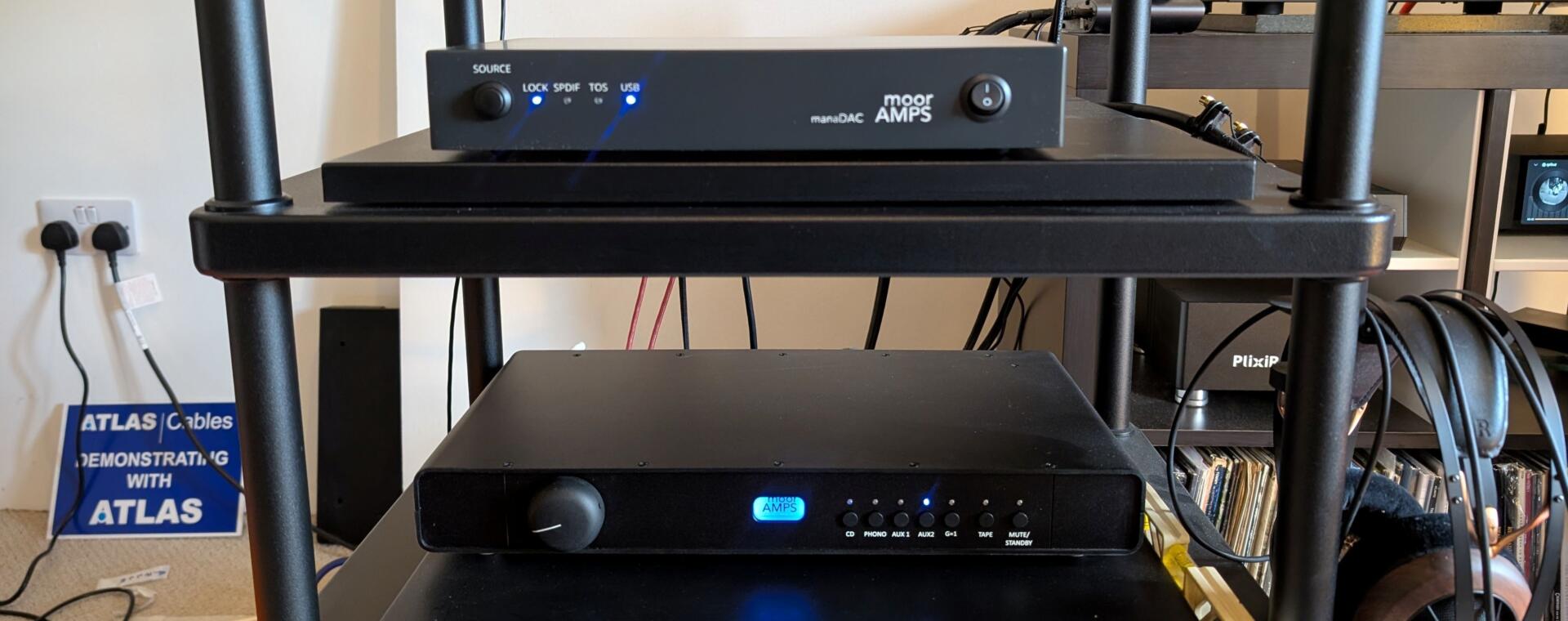
For amplification, I have the peerless Moor Amps Angel 6, paired with the Moor-Pre preamplifier. I’m using Tellurium Q Ultra Silver II XLRs between the amplifiers and their Ultra Silver II loudspeaker cable. The passive Kudos Audio 505s loudspeakers are being driven by the Angel 6. The active PowerGrip YG-2 remains a significant component of this setup.
Physically
The manaDAC sits perfectly on my Solidsteel rack, with plenty of space at the rear for manoeuvring. On first firing up, I usually leave things to warm up, but the manaDAC seems to sing out of the box, even though it has over 100 capacitors. Half an hour in, though, I’m even more impressed.
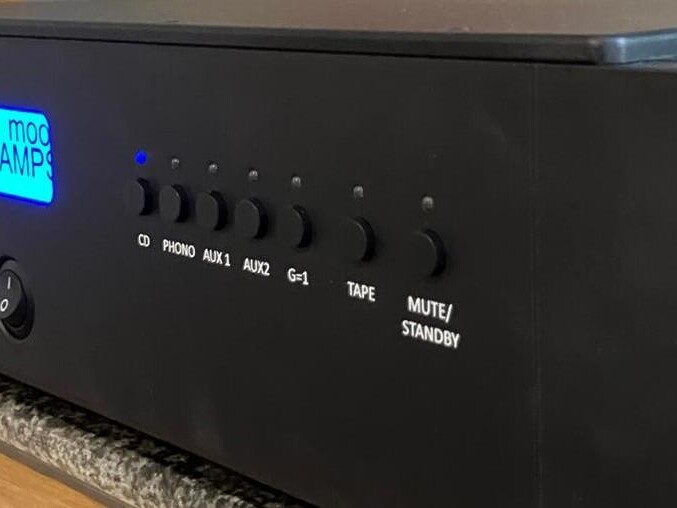
There is a light with Lock on it next to the chosen input that you scroll to using the source button to the left; there’s no remote control. When your source is selected and the input signal is received, the blue Lock light comes on, confirming your source is live.
Albums
On first plugging in the manaDAC, something exciting happened. With the ‘revealing’ Titan 505s in tandem, I was unexpectedly hit by a load of information (some may call it a Wall of Sound!). Details I had never heard before. At first, this was quite a thing, but after a bit of time, my listening and, more importantly, my brain adapted to the effect. What emerged was revelatory. It was detail and clarity, with more dynamics and more imaging.
I conclude that I have a smoother, more detailed sound wave delivered to me over some of the more analytical DACs available. However, where the Kudos Audio 505s are usually particularly upfront, they appear to have been tamed by this DAC design and presentation.
And so, this is one of those pieces of audio equipment that makes you want to play albums. Why is that? With this audio clarity and detail comes a smooth, warm, relaxing feel. It’s just so easy to listen to music endlessly.
For me, my go-to album of all time is Ryan Adams’ Gold. This album has rhythm, timing, and it is cinematic, emotional and vulnerable. It is also forward-looking, and it became a bit of a symbol of resistance, released just a few weeks after 9/11. The opening track, New York, New York, still sounds just as vibrant and fresh every time I fire it up. The manaDAC offers that incremental step up in presentation and musicality we all crave with a near-vinyl feel. Indeed, this is like putting on a vinyl record and not having to get up to hear Side 2 (or 3 or 4, in this case)!
The manaDAC does this without the plethora of DAC filters that are offered to confuse the casual listener into hearing things that may or may not be there. There is undoubtedly more weight and depth in the soundstage that has a pitch-black background, offered by this combination of Pre and Power Angel amplification and the DAC processing itself.
In peaceful reflection whilst making notes to Miles Davis’ Flamenco Sketches (all nine minutes of it), that brush of the snare and the bass decay are simply head-turning. That saxophone is like being in the club itself; it is so atmospheric.
Other Albums
It is not just Alternative Americana and Jazz that fare well with this manaDAC. Gentle New Yorker Amos Lee’s eponymous album eases by with such emotion as does Ray LaMontagne’s beautiful and heartfelt album Trouble. Shelter, in particular, with the bassline decay, has depth and strength in the isobaric 505s. Classical music clips along with ease, Max Richter’s Recomposed Four Seasons is stunningly incredible with this presentation.
CD Transport
Using an Audiolab 7000CDT transport with an Optical Toslink connection, the same album, Gold, on CD is just as lively and pacey, though the streamed or 24-bit Melco library copies possibly take it in preference. The same is true of Max Richter’s Four Seasons on CD. I gather the jitter in the optical input is an order of magnitude greater than that in the USB input, which is reclocked inside the chip. Still, there’s absolutely nothing to complain about with the easy analogue feel dominating the presentation.

Musical Interlude
Here’s the Qobuz playlist with the tracks mentioned and used in the review process. Key whole albums for me include Amos Lee’s first album, Ryan Adams’ second album, Max Richter’s recomposed Vivaldi Four Seasons, as well as Amnesiac from Radiohead.
My Naim Audio Slave to the Rhythm Playlist has received a lot of listening with this manaDAC.
Thoughts on DACs
This Moor Amps manaDAC is built like an amplifier, with ‘over-engineered’ power supplies focusing on analogue purity. It’s deliberately simple in digital terms, sticking to PCM only, with no DSD. The design ensures pitch black background noise levels and musical timing. There is no digital fuss here with this DAC; it just focuses on organic, vinyl-like presentation over sheer digital resolution.
I have come a long way in my understanding since my original first DAC investment with the Musical Fidelity M1 DAC. The T+A DAC 200 was undoubtedly the best DAC I have ever experienced before this review. It, too, was simple in design and application; despite the myriad filters, it was easy to navigate and even easier to appreciate.
I have been a firm devotee of the iFi Audio Pro iDSD DAC for years, thanks to its comprehensive file handling, flexibility, and headphone stage. Their Valkyrie is possibly the most complete DAC performer with a battery-backed headphone stage with portability to boot.
I have not had an extended listen with the Chord Electronics Qutest, the Hugo is as close as I’ll get to that, and of course, on the desktop, ‘Nothing Compares to U (Hugo 2)’.
However, if you step back from all of this, you don’t really need to fuss with oversampling/NOS or filters with obscure names like Natural Tone, Bezier, FIR Long, etc. Indeed, in a HiFi setting, portability, filters and three different headphone outputs are tertiary needs. You don’t need any of it, really. You want to settle in for a bit of high-quality listening; the manaDAC has it all done for you.
Overall
This manaDAC is genuinely in a league of its own, in my view, offering what could be described as the most analogue DAC experience available. I will be putting my name down on the apparently long order book for the manaDAC.

Moor Amps manaDAC Highlights
Love
- No filters
- It’s just a DAC
- Pitch black background
- Analogue delivery
- Vibrant, long listening
Like
- Minimalist styling
- Physical Weight
Wish
- Input sample rate indicators
- Some may want DSD support, but I don’t need it
Related Posts