Introduction
Electrostatic speakers were once a mystery. I saw these hybrid-design Martin Logan ESL X loudspeakers at Bristol last year, as well as QUAD’s full-range, therefore massive, electrostatic loudspeakers at the same show. This was on the back of an introduction to Martin Logan for a few hours at the beginning of last year. I carted my (also massive) Moor Amps Angel 6 to the ESL 11As on a wintery excursion and was left with deep admiration of the soundstage and a desire for more time with them, and here I am…
Design
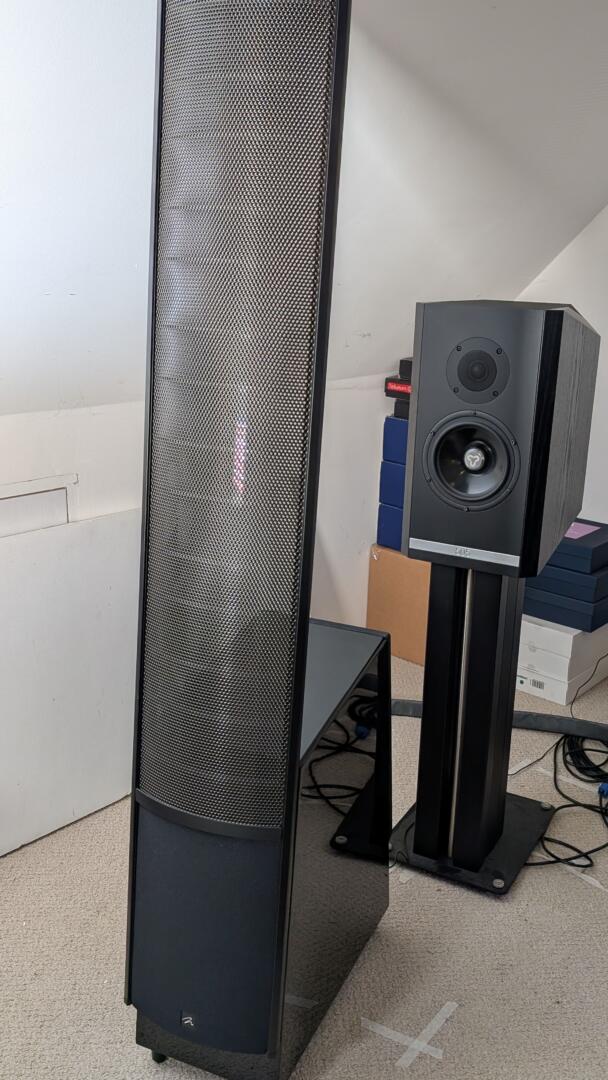
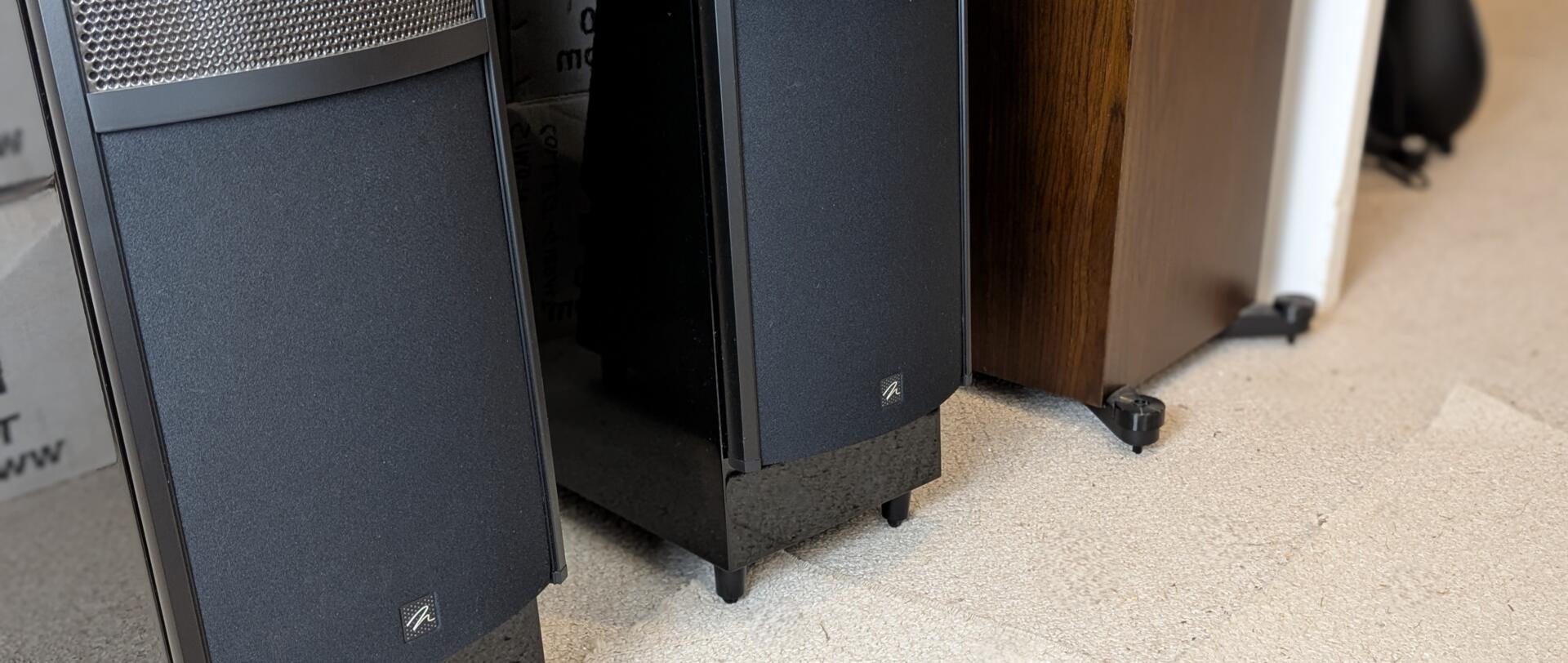
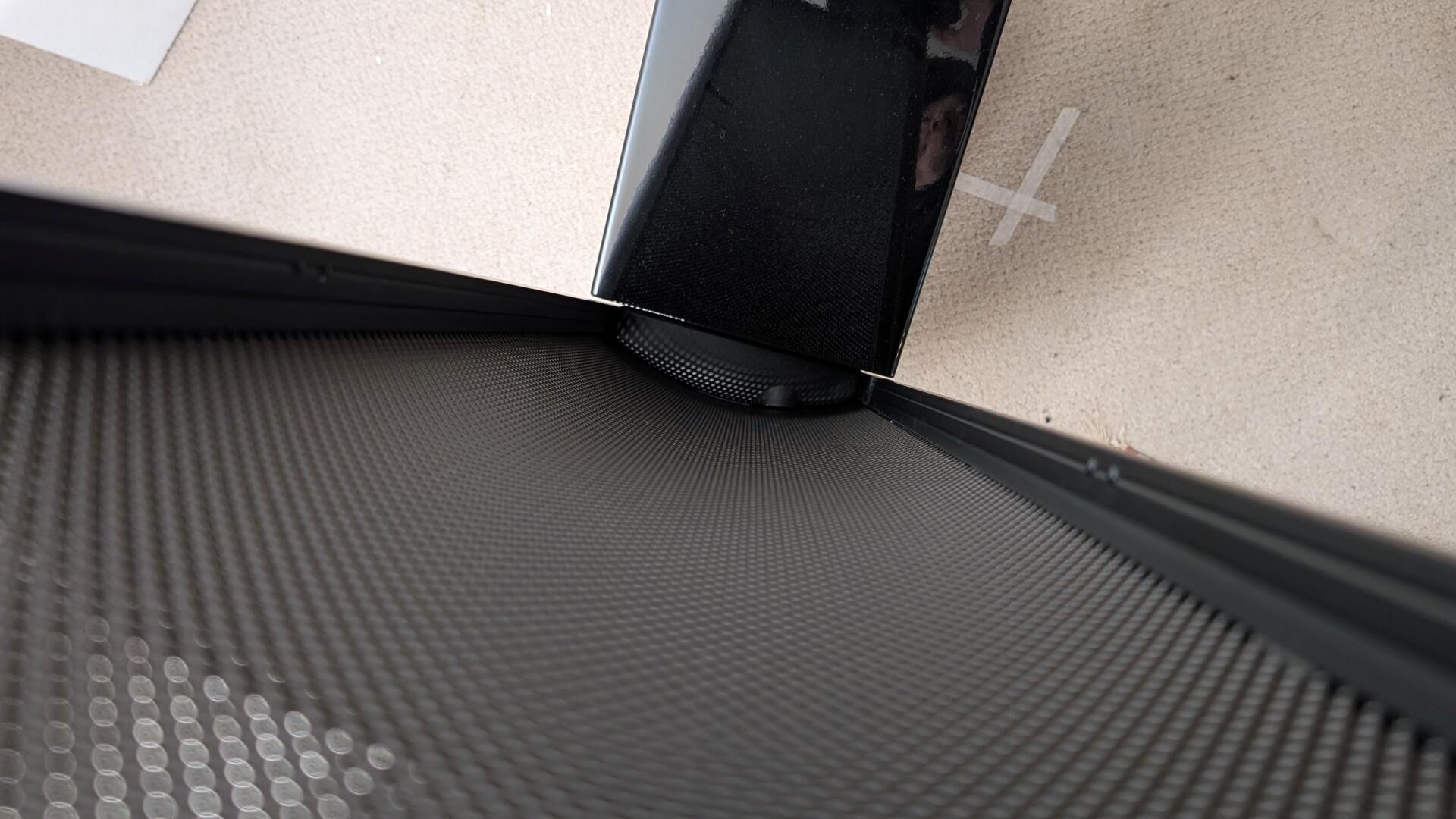
The ElectroMotion ESL X is a hybrid design electrostatic loudspeaker with a ‘blade-style’ transducer and a separate ‘sub-woofer’ housed in the base of the unit (it takes over below 400Hz). It features a new, larger XStat™ electrostatic transducer with a radiating area more than 50 square inches larger than the EM-ESL model. Each ‘blade’ is mounted on an enclosure that houses an 8-inch woofer in a non-resonant asymmetrical bass ported chamber. The woofers are custom-made high-rigidity paper cones, with extended-throw driver assemblies. The base chamber features sturdy spikes with removable rubber end caps for those who prefer not to use them.
The transducer features proprietary CLS (Curvilinear Line Source) technology, which uses a horizontal curvature that ML claims solves the problem of achieving good high-frequency dispersion from a large radiating surface.
Quality
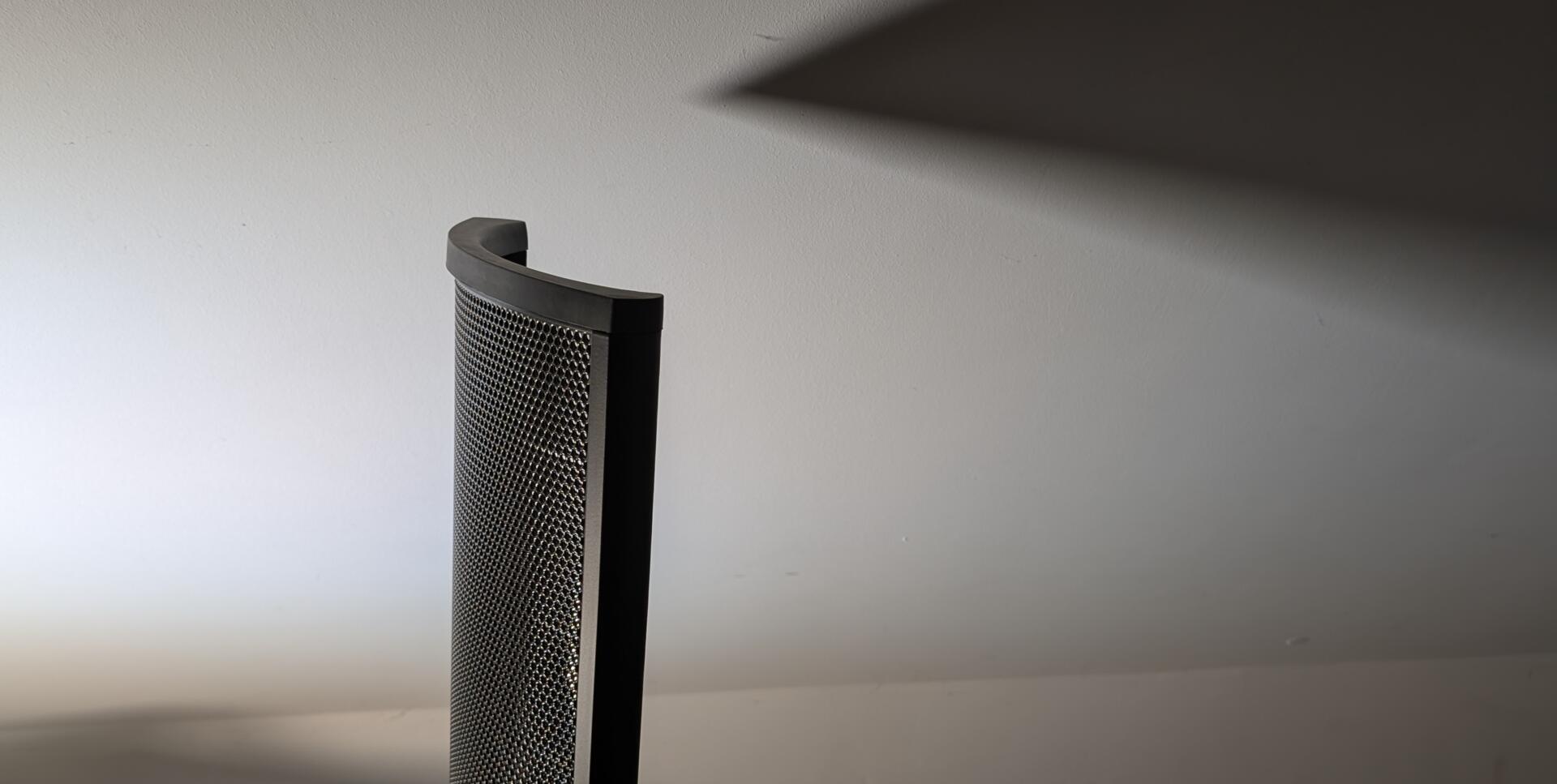
The Martin Logan ESL X units are awkward to handle, and fortunately, mine were delivered and installed carefully for me, to my Naim Audio NAP 250. I’ll go on to explain why I had to move them below, but when I did it was definitely a two-person job with the relationship between the weighty bass box and the ‘blade’ feeling fragile.
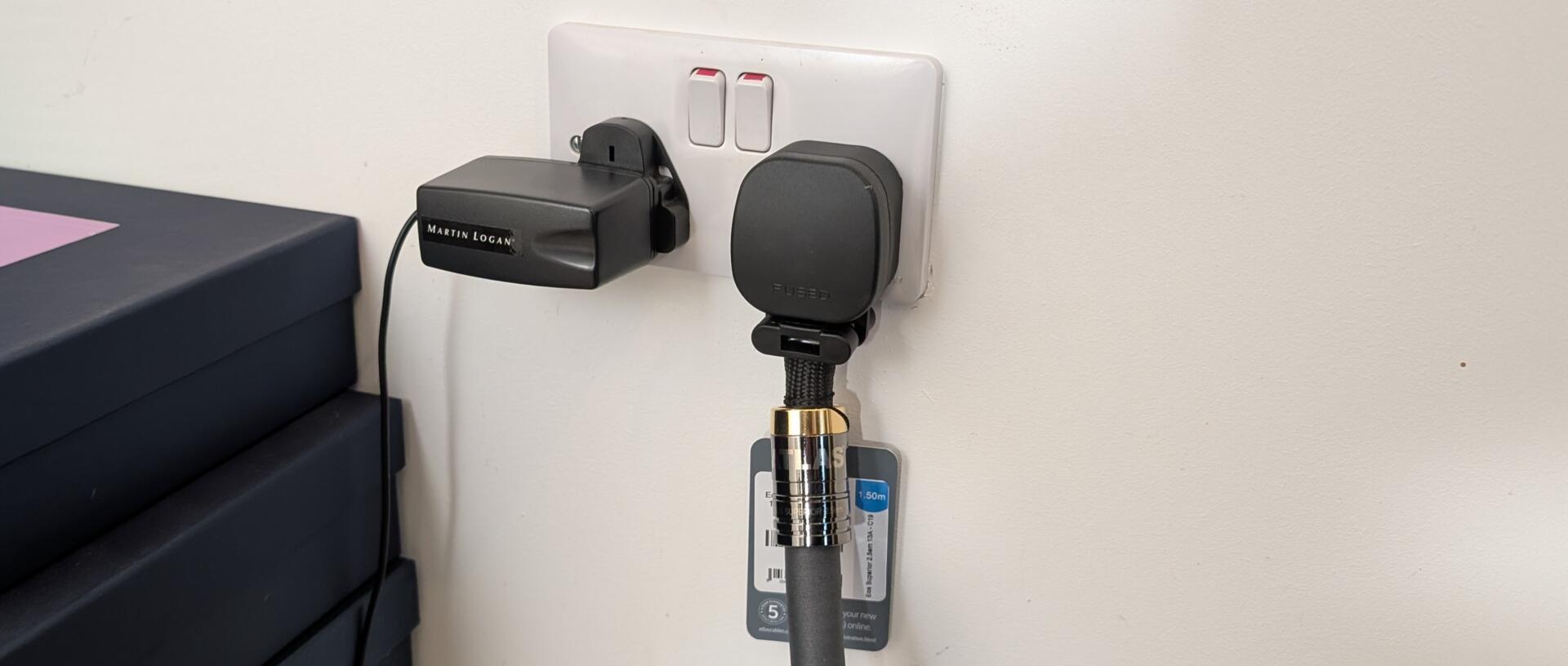
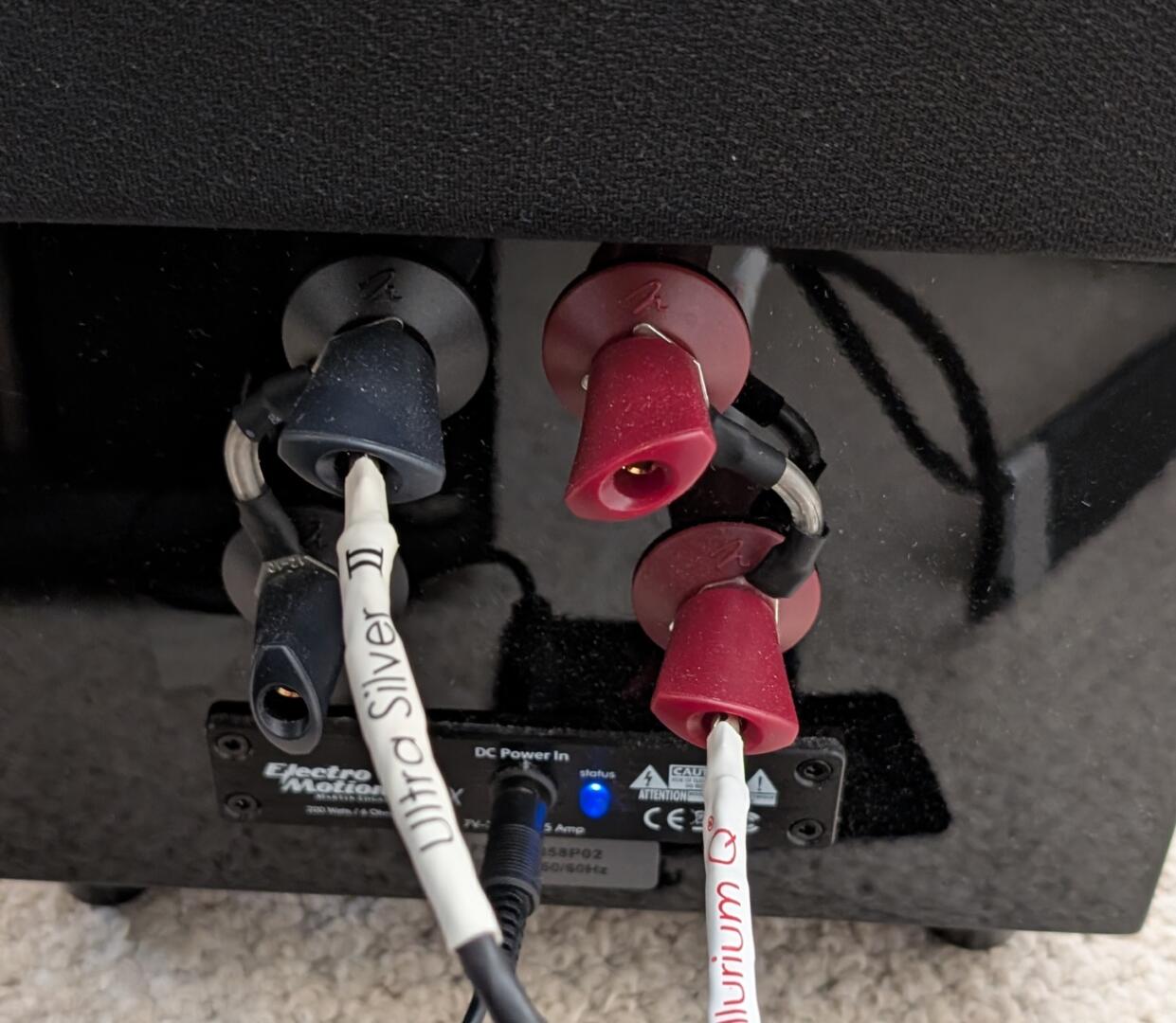
Otherwise, the feel and finish are high quality, and once in place, there are no issues; they are conversation pieces every time someone sees them. The units need to be plugged in, and the loudspeaker cable must be connected. A rear-facing LED confirms supply, though it would be more helpful (to me) if this indicator were on the front of each unit. The plugs for the bass units use a branded but lopsided plug; this is a pain when used with power conditioners and other units.
Specification and Price
Martin Logan ESL X Specification
Frequency Response 41–22,000 Hz ±3dB
Recommended Amplifier Power 20—400 watts per channel
Horizontal Dispersion 30°
Vertical Dispersion 40″ (101.6cm) line source
Sensitivity 91 dB/2.83 volts/meter
Impedance 6 Ohms, 1.6 @ 20kHz Compatible with 4, 6, or 8 Ohm rated amplifiers.
Crossover Frequency 400Hz
High Frequency Transducer – XStat™ CLS™ electrostaic transducer » Panel Dimensions: 40″ x 8.6″ (102 x 22cm) » Radiating Area: 344 in² (2,244 cm² )
Low Frequency Transducer – Two 8” (20.3 cm) high excursion, high-rigidity paper cones with extended throw driver assembly, non-resonance asymmetrical chamber format, bass reflex.
Components – Custom-wound audio transformer, air core coils, large steel laminate inductors, polyester capacitors, and low DF electrolytic capacitors
Inputs – Custom 5-way bi-wire tool-less binding posts,
Weight 52 lbs. (23.6 kg)
Dimensions 59.2″ x 9.4″ x 20.7 ” (150.3cm x 23.8cm x 52.6cm)
Available online here.
Dealer Network here.
Retail Price £5500


Performance
Review Equipment
I’m using a Melco-based source on the quiet side of an ADOT optical data converter, paired with the Eversolo DMP-A6 as a streaming transport, mainly with Tidal or Qobuz Connect. The manaDAC is doing the heavy lifting here; it is still perfect. I have an Atlas Mavros USB with Grun between the transport and the DAC.
For amplification, I have the peerless Moor Amps Angel 6, paired with the Moor-Pre preamplifier. I’m using Tellurium Q Ultra Silver II XLRs between the amplifiers and their Ultra Silver II loudspeaker cable to the ESL X.
Physically
The ESL Xs are around 1.5m into the room from the rear wall, in front of the Kudos Titan 505s they replace. In a sloped ceiling space, they’re around 80cm from the side walls, and I’m about 3 meters away. I have the ESL Xs angled in towards me. I read online that I should shine a torch from the listening position to the panels to ensure I had the correct alignment. With the torch reflection on the inside third of both panels, I was in a prime position.
The panels are imposing monoliths and nothing like as classic looking Titan 505s they replace.
Performance
Initially, I had the ESL Xs hooked up to my Naim Audio Old Classic NAP 250 (not DR). However, this did not work for me at all. The sound was thin and uninspiring. I think the main problem I had was that there was a limited bass response, which seemed strange, and there was no timing at all.
After a while, I was able to move the ESL Xs into my demo room with the Moor Amps Angel 6 power amplifier, which, as we all know now, is a low-feedback, high-current amplifier. The Angel 6 is designed to be so stable. With an electrostatic panel, the impedance varies across the frequencies; this stable design is perfect, luckily for me (and Martin Logan).
Electrostatic panels have almost zero mass and can move instantly. However, the amplifier must provide the “speed” to match. The high-current design of the Angel 6 can track the lightning-fast transients of the ESL X panel with precision. Separately, because the ESL X is a hybrid design with a separate (sub)woofer cabinet, it can be difficult to drive, timing-wise, with the super-fast, weightless panel. The Angel 6 can drive the 8-inch woofers, ensuring they stop and start exactly when the signal tells them to.
And, with the correct amplification, how does it perform? This presentation is all about soundstage, without a doubt. The soundstage issecond to none, and it’s a complete joy. Of immediate note is the space in the room. When I played, out of curiosity, Tom Waits’ $29.00 (Tidal 24-bit, 192 kHz), the track was the definition of him being ‘in the room’, incredible, what a sound. The vocals are as raw as the microphone being used to record the track.
Similarly, live tracks seem to have a sense of air and space; for example, Ryan Adams’ Sylvia Plath from the 2015 Live Carnegie Hall concerts is so delicate and intimate. The same is true for The Staves’ heartfelt cover of Ray LaMontagne’s Jolene (Tidal, 16-bit, 44.1kHz). Absolutely glorious, the vocal is held absolutely in the centre of the soundstage, there’s no compromise.
Just about everything I’ve played has sucked me in, be that Taylor Swift’s collaboration with Bon Iver (exile), Sarah Vaughn (Lullaby of Birdland) or Carla Bruni (Enjoy the Silence). Classical music fares well here, too. Lang Lang’s Liebesträum No.3 is captivating, as is the swirling second piano concerto from Rachmaninoff. I still prefer Ashkenazy’s version with the London Symphony Orchestra over the one in my Playlist but it is the space and ease with which the music washes over you that leaves you to grab a cup of tea and settle in for longer sessions listening to variations on the same piece as in Rachmaninoff’s Piano Concertos.
What I have to say is that these loudspeakers need to be driven for full effect, but that is absolutely not a chore for me. Billie Eilish’s Lo Vas A Olvidar is a case in point; that bass response is there, in control, but it needs a bit of volume. Her track WILDFLOWER is remarkable here too, with her breathless vocal to the fore.

Music
I’ve got an ESL X Tidal Playlist here, and the one I used for my brief encounter with the ESL 11As is here (see what I did there?).
Thoughts
For me, these loudspeakers are breathtaking and as good an experience as I have ever had here at HF&MS. It is going to be hard handing them back, but I am reverting to the Titan 505s, so things could be worse, whilst I understand what a difference in philosophy this is. Essentially, as a reviewer, I need the clarity of the 505s.
The amplifier issue stands out, too. Although it was in a different room, these ESL Xs were not engaging at all with my Naim Audio NAP 250, which I am generally very happy with. A service is due, I am sure, though, financing permitting, I may go for the Avondale solution that was outstanding. I’m advised that the Audiolab 9000 power amplifier may be a suitable solution with these loudspeakers. I certainly had an excellent experience with that stack.
Choosing a pair of loudspeakers is entirely subjective. Here with the Kudos Titan 505s, I have unrivalled timing and rhythm. The Martin Logan ESL X clearly have beautiful transparency and soundstage, and is very easy to listen to in extended periods. If you have a larger space, the ESL Xs will serve you well if you are happy with the look and you have the amplification to match. If you have an Angel 6, you do have choices. These ESL Xs are easily the most fun I’ve had in a long time and will have for a while, I’m sure.
Overall
I would, without hesitation, take a Moor Amps integrated 4i and pair it with these Martin Logan ESL X loudspeakers; with the right amplifier, they are relaxed, transparent and simply joyful. It’s an Editor’s Pick; I just want to retire with these loudspeakers.

Martin Logan ESL X Highlights
Love
- Incredible soundstage
- Live feel
- Easiest listen
Like
- Conversation starter
Wish
- The lopsided plug was more sensible (very minor)
- Easier to move
- ‘On’ light at the front would be useful
Related Posts
Kii SEVEN active speakers – major software upgrade

Kii SEVEN active loudspeakers that have received…
Cambridge Audio launches The L/R Series
Today, Cambridge has announced a new L/R Series…
Edifier S880DB MKII Active Hi-Fi Speaker

Edifier S880DB MKII Actives deliver impressive…
HF&MS Product of the Year – Focal DIVA UTOPIA
HF&MS Product of the Year - Focal DIVA UTOPIA
Best of 2025 – REL T/9x SE Stereo Pair
Best of 2025 - REL T/9x SE subwoofers in a stereo…