
Introduction
ADOT is the brainchild of Alan Ainslie, whose resume in the audio industry could take up a page on all its own. To summarise, he was responsible for launching Technics UK. He continued to run the company for a further two decades, during which he oversaw the success of the legendary 1200/1210 turntables and sat on the CD standards committee before the launch of the compact disc medium. He has since held senior positions at several major brands, including Naim Audio, Chord Electronics and ATC. More recently, Alan launched the Melco brand in the UK in 2014. Melco, of course, is now known as DELA, with whom Alan still acts as the distributor through his company, ADMM.
I have been enjoying the benefits of the original ADOT MC02 SFP converter since its launch, and am a convert to this method of reducing network noise. The MC range can be purchased singularly to feed a network switch, streamer or server with an SFP input, or, via a second unit, any of the above via an Ethernet socket. The concept here is that converting from Ethernet to Fibre Optics breaks the electrical connection, which reduces noise picked up by your router and Ethernet cables. ADOT also claims that the SFP conversion process helps preserve the signal’s timing integrity. Their website provides further information, including graphs.
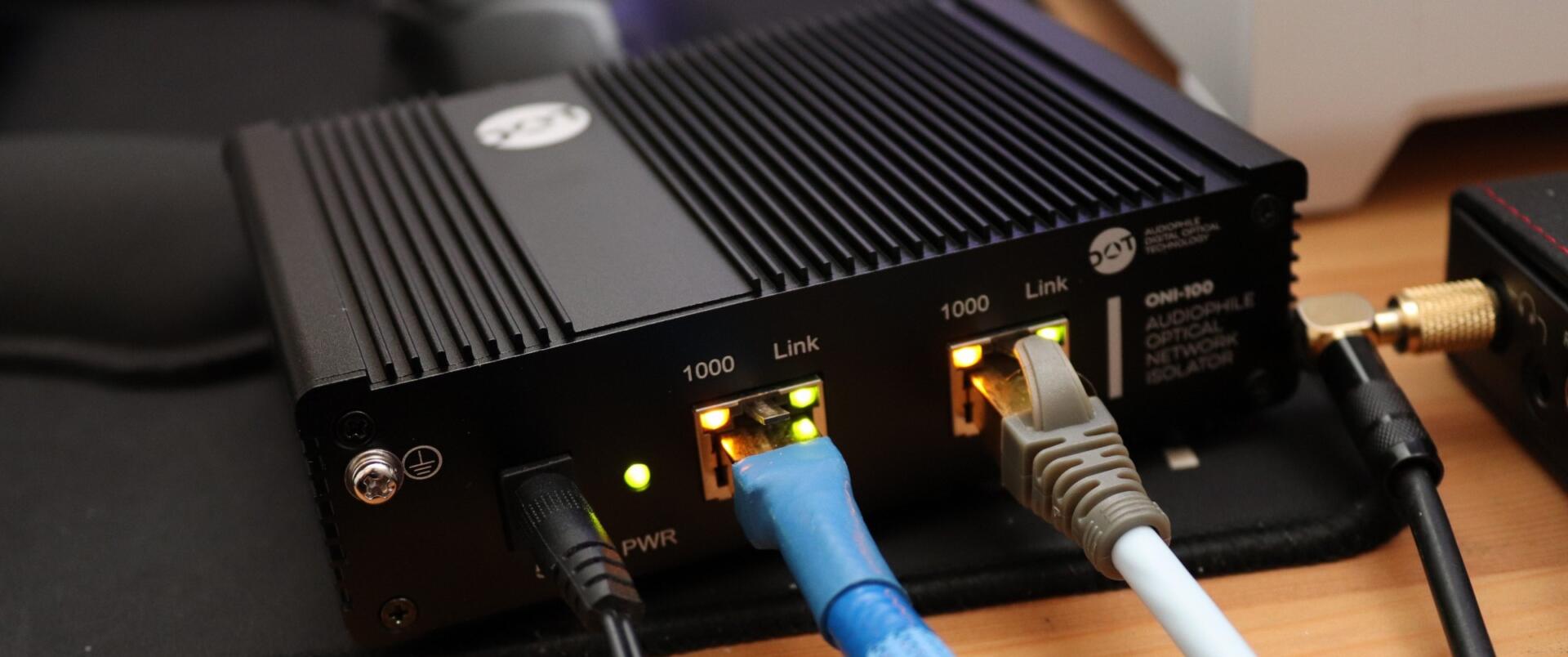
The ADOT ONI-100 was conceived for the streaming enthusiast who would have previously considered buying two ADOT units to feed their switch or streamer via Ethernet. If you have a network switch which includes an SFP input, such as one from the Melco range, or you don’t use a switch but have a streamer with an SFP input, such as a higher-end Melco server, or a Lumin streamer, then an ADOT MC01, MC02, or MC03 will make more sense. ADOT states that the ONI-100 is the performance equivalent of two MC02 units but occupies less space and costs considerably less.
The ADOT ONI-100 is supplied with a decent ‘wall wart’ type plug-in linear power supply (LPSU), which is seemingly identical to the unit supplied with the ADOT MC02 units. As with the MC range, users can upgrade to a larger LPSU, such as a Plixir unit, which is also distributed by ADOT’s parent company, ADMM. Doing so should further improve performance, as I can attest, as it was when I obtained a Plixir LPSU for my MC02 unit, which effectively turned it into an MC03.
How Does The ADOT ONI-100 Perform?
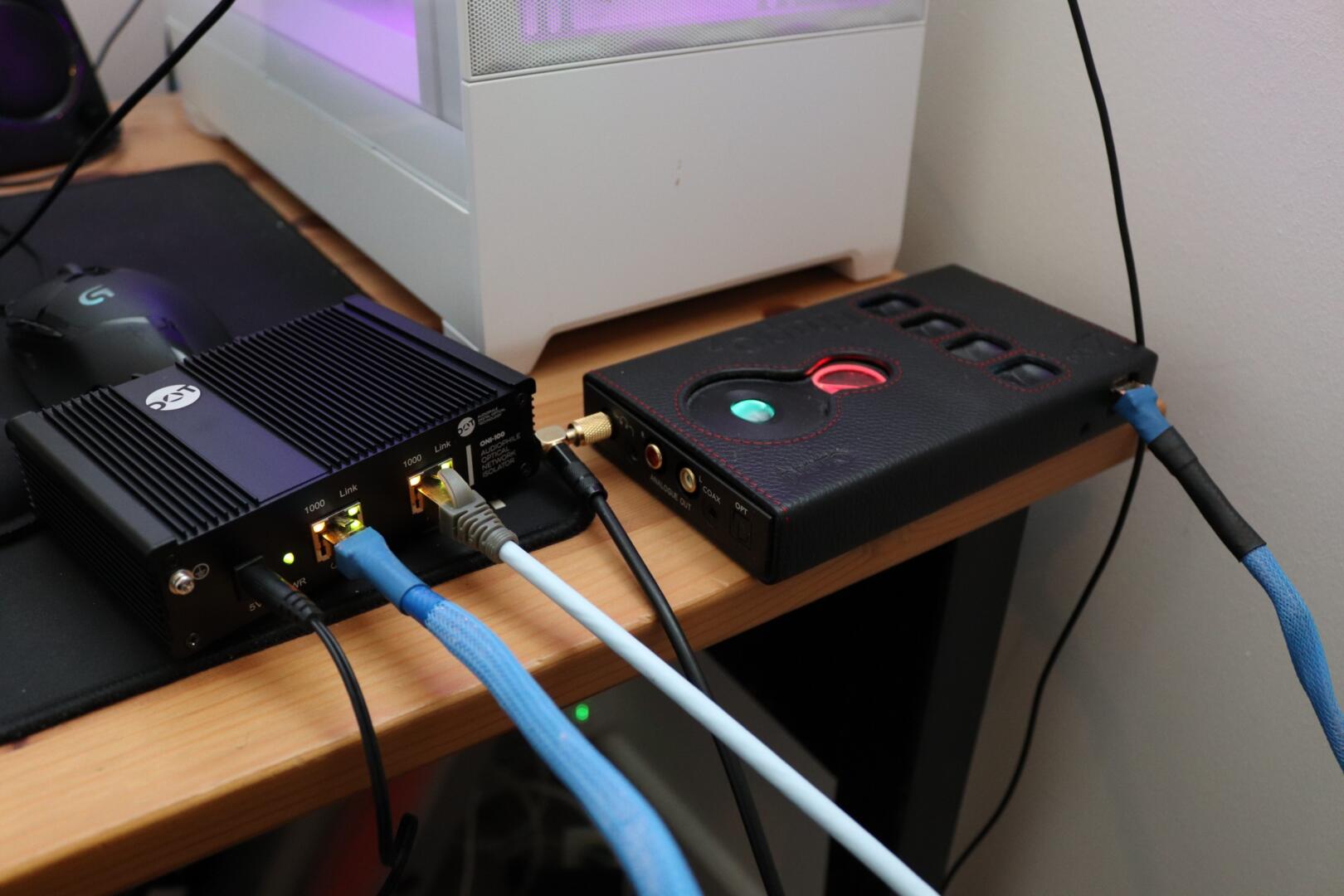
As Ethernet to my main listening room is supplied via an SFP cable, it does not fit the criteria for which the ONI-100 was conceived. So to assess the ONI-100, I listened to a few tracks via my Chord 2Go/Hugo2 streamer/DAC fed directly from the router, then slotted in the ONI-100 between the router and the Chord device and repeated the same tracks. This is an office-based setup, so a pair of HiFi Man Sundara headphones was pressed into action.
Using the JPlay control app, I streamed music from my Melco N1-S38 server, which sat in another room, over my local network. No network switch was used during these comparisons. For reference purposes, I started with a few tracks I had recently played on the main system. First, I listened with the Chord Streamer/DAC connected directly to the router; second, via the ADOT ONI-100; then repeated the process twice more. I used the same Supra Ethernet cable from the router each time. An AF Audio Ethernet cable was used between the ADOT unit and the streamer.
First up was Loran’s Dance, from a CD rip of Idris Muhummed’s sublime Power Of Soul CD. My headphone setup always sounds like a comedown after listening to my loudspeaker system. Sure, it can be easier to pick out fine details in a recording, and, naturally, the music is unhindered by room reflections. Still, I find you never get quite the same sense of power and immediacy, even on the best setups. Even so, the track sounded particularly flat and uninteresting by comparison. It took just a few seconds to appreciate the improvements once the ONI-100 was in circuit. The opening bass notes were better defined, with more resonance and ambience, which was a theme throughout the comparison process. This recording does not have the deepest soundstage, but it now has at least some depth. The keyboard intro had more life and was better refined, and, indeed, more detail was resolved. The music sounded warmer and more organic; I could say darker, but there was simply less glare to the high frequencies, especially when Joe Beck’s electric guitar comes in, which was now more finely revolved, revealing more texture.
Next up was Bob Marley’s Coming In From The Cold, from the 24/96 download of his Uprising album. Here, there was more snap and life to the music and again, less glare, especially from the cymbals and, as with the Idris Muhummed track, the electric guitar. Again, much of the brightness and glare had subsided, so the music sounded more organic and natural. I do not doubt that listening again with a good network switch in the chain could further improve things, but still, the ADOT ONI-100 was having a positive effect.
UNKLE’s Lonely Soul, from a CD rip of their debut album Psyence Fiction, was up next. A flat, blobby sampled bassline greeted me initially. Adding the ADOT was like going from an MP3 file to a .wav file, such was the increase in life and apparent resolution. What’s more, that bassline, subjectively, appeared faster. Cymbals were better defined and resolved, leading to less glare. The drum track started and stopped with greater alacrity, giving them more impact. Overall, this was now a far more involving listen.
The ADOT injected some much-needed life to Bob Dylan’s Tangled Up In Blue from my DSD rip from the Sony SACD of Blood On The Tracks. Here, the acoustic guitars had more definition, resonance, body and warmth. The vocals on this recording will always sound slightly shut in, but the effect is less distracting as the system improves, and this was the case once the ONI-100 was in the circuit. This is a busy recording, but the ADOT reduced congestion, making it easier to follow each instrument. Again, the ADOT cleaned up the cymbals and breathed life into the Hammond organ of Idiot Wind, which is one of my favourite tracks on this album.
None of the aforementioned tracks is what you would call ‘audiophile’ recordings. I’ve no doubt there are better recordings out there than Hania Rani’s Inner Symphonies (24/48 download), but it is a pretty good one, which is full of detail and dynamic contrast. This superior recording proved to be the ONI-100’s biggest success. Piano notes are fuller and far better resolved, and have more tonal colour. The album’s quieter moments were often ill-defined and rather muted with the streamer connected directly to the router, but not now. This device from ADOT strips away the mud and shines a light on proceedings, whilst, paradoxically, reducing glare from the high frequencies. Violins had more woody warmth, despite being better-defined and more vivid. This album does have a good degree of stereo depth, which the ADOT made easier to appreciate. The whole performance took on an organic, cinematic quality, which I am used to hearing in my main setup.
Conclusions
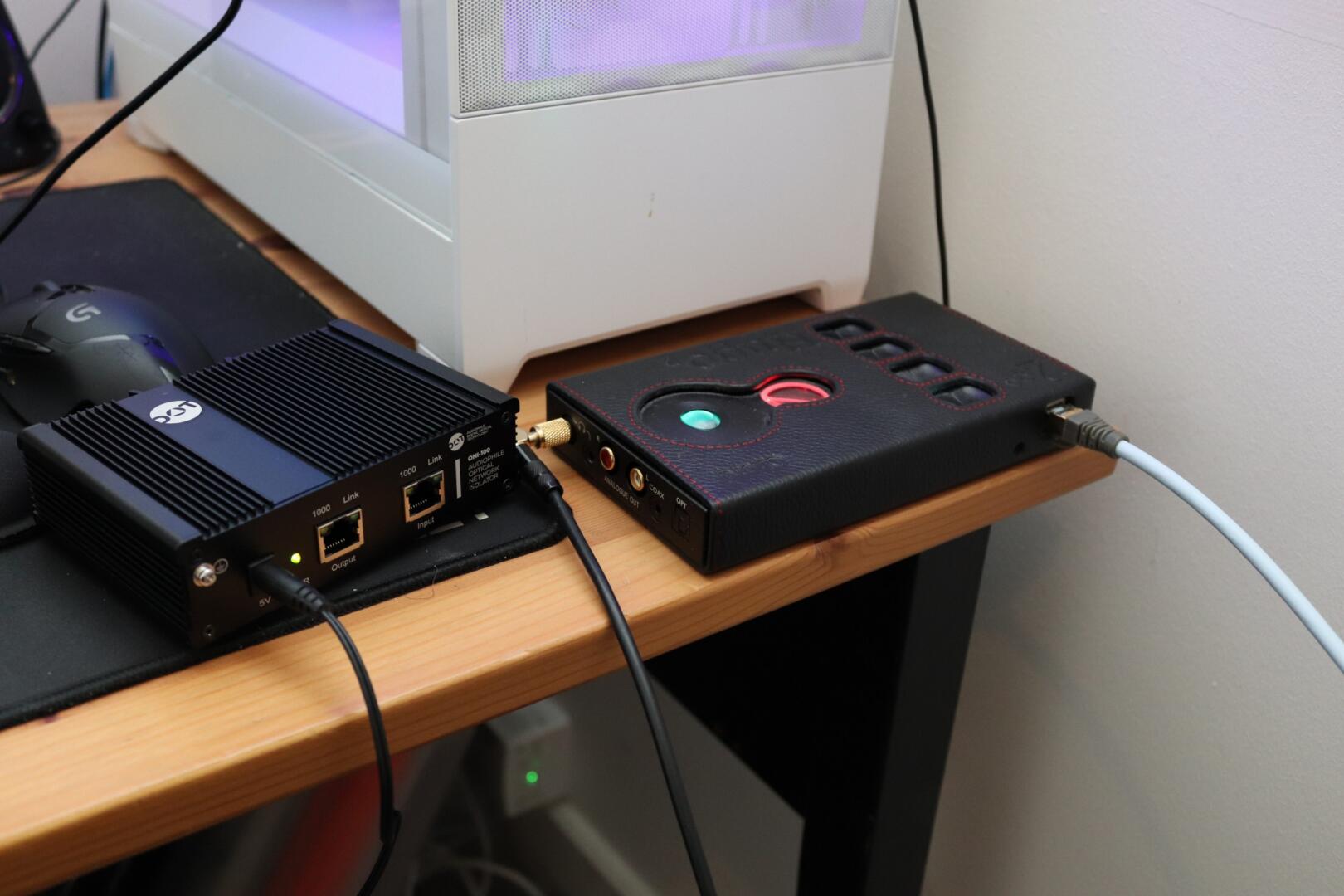
As I have mentioned, my previous experience with ADOT SFP conversion involved a premium-priced network switch doing the back conversion to Ethernet. So I did not really know what to expect from the ONI-100. While £500, plus the cost of an extra Ethernet cable, is not beer money, it is pretty good value for the performance uplift I experience in what is not especially expensive a headphone setup.
Previous experience led me to anticipate improvements in soundstaging and low-level detail, which I did indeed hear. The killer, and unexpected benefit for me, was the increase in musical warmth and the reduction in glare.
I heard no adverse effects from the SFP conversion process, only the benefits mentioned, which makes this product an absolute no-brainer for suitable setups. If you already have a good switch without an SFP input, then the ONI-100 is the best option for you. If you have, or intend to buy, such a switch, such as the Dela S5 reviewed last month, then the ADOT MC02 or MC03 would be your best option. Either way, the ADOT ONI-100 does precisely what it says on the box and gives owners of suitable, high-quality streaming systems another option to help further enhance listening pleasure—highly recommended.



ADOT ONI-100 Optical Network Isolator Highlights
Related Posts

DELA Audio Introduces the S5 Audiophile Dataswitch

DELA, formerly known as Melco, has announced the…

Best of 2024 Concludes with Outstanding Product of the Year
The HF&MS Best of 2024 Awards Season concluded…



